

How Jamaica Osorio uses poetry to navigate grief, forge solidarity, and demand a decolonial future
…I have no conception of how we could have allowed
A world quite like this to exist
Where somewhere thousands of miles away and yet close all the same
A beautiful Palestinian child could be dancing
while her grandfather sings a song written long before the birth of our occupiers
But instead
Both precious beloveds are martyred
and with them
another family wiped from the civil registry
and with them
another universe foreclosed from possibility
I sit split in half
at the boarder of these two realities
at the margins of these overlapping worlds
They are both mine
To know
and to hold
I dare not look away
–“Its time to dance” by Jamaica Osorio
In this episode of the Speaking Out of Place podcast, Professor David Palumbo-Liu talks with poet, activist, and scholar Jamaica Osorio. Shortly after October 7, 2023, she began to write a series of astonishing poems about the war in Gaza and the genocide. Osorio graces us with readings of some of those poems, and engages in a rich, complex, and deeply moving discussion of what went into their composition. Throughout, we talk about the power of poetry to suspend time and allow us the space to contemplate the impossible. We talk about the nature of not knowing, of the inexpressible, and the ways certain poems can give us the strength, energy, and commitment to persist in working for the liberation of all peoples, even when dwelling in grief.
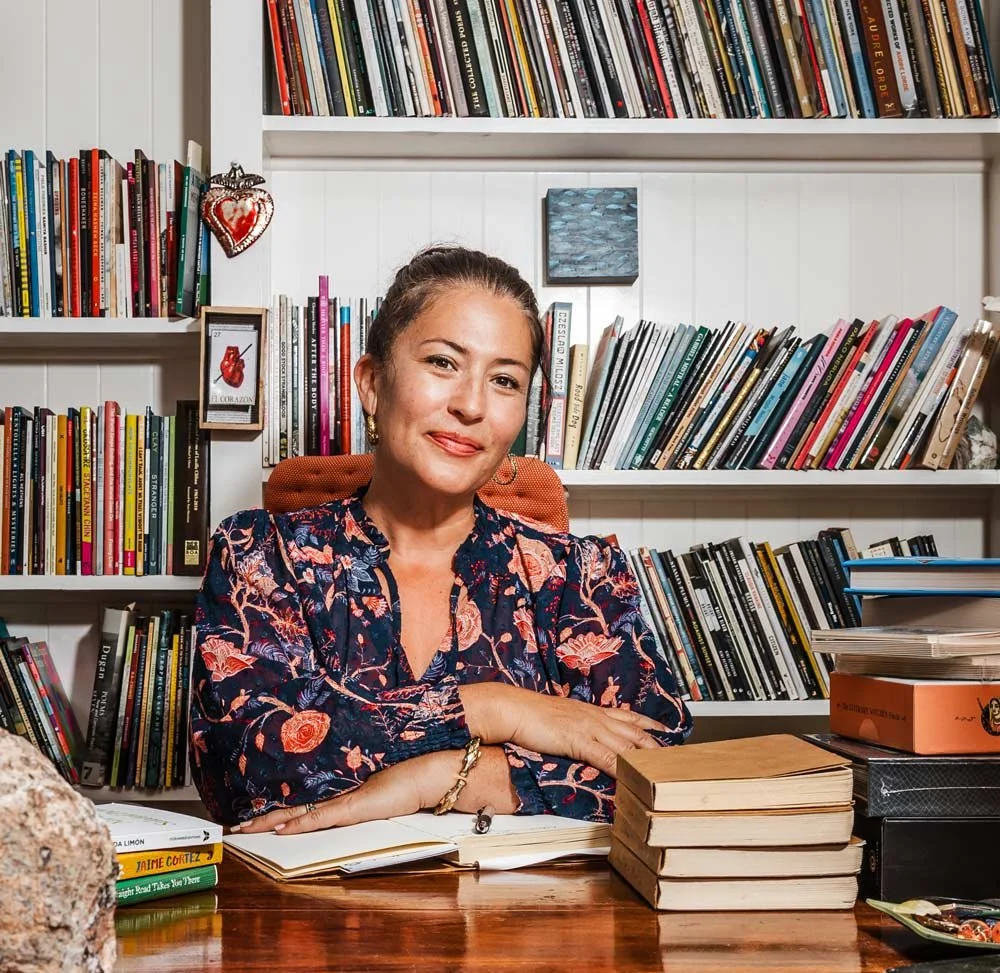
Dr. Jamaica Heolimeleikalani Osorio is a Kanaka Maoli wahine artist / activist / scholar / storyteller born and raised in Pālolo Valley to parents Jonathan and Mary Osorio. Jamaica earned her PhD in English (Hawaiian literature) in 2018 from the University of Hawaiʻi at Mānoa. Currently, Jamaica is an Associate Professor of Indigenous and Native Hawaiian Politics at the University of Hawaiʻi at Mānoa. In 2020 her poetry and activism were the subject of an award-winning film, This is the Way we Rise which premiered at Sundance Film Festival in 2021. In 2022 she was a lead artist and Co-writer of the revolutionary VR Documentary, On the Morning You Wake (To the end of the world), that premiered at Sundance Film Festival 2022 and won the XR experience Jury award at SXSW 2022. She is a proud past Kaiāpuni student, Ford Dissertation (2017) and Post Doctoral (2022) Fellow, and a graduate of Kamehameha, Stanford University (BA) and New York University (MA). She is the author of the award-winning book Remembering our Intimacies: Moʻolelo, Aloha ʻĀina, and Ea which was published in 2021 by The University of Minnesota Press. She believes in the power of aloha ʻāina and collective action to pursue liberatory, decolonial, and abolitionist futures of abundance.
Speaking Out of Place is produced in collaboration with The Creative Process and is made with support from Stanford University.
DAVID PALUMBO-LIU
Thank you so much for being on the show and especially for these three incredible poems that you shared with me having to do with Palestine. I'll tell you the honest truth, I had left the poems on the living room sofa and came back to find my wife reading them. She asked who wrote these, so it is really precious for you to spend time with us. You managed to express the inexpressible, and I hope you'll be willing to read and discuss any or all of the three poems.
That will be the focus of our conversation. But before we get to those readings and discussions, I'd first like to ask you what led you to write them? That's a big question, obviously, because a lot of the poems are about the inexpressible. How does the poet sit down to write the inexpressible?
JAMAICA OSORIO
That's a great question. When October 7 happened, my partner—who has been to Palestine and whose closest friends are Palestinian organizers from the Bay Area—reached out to all her friends. We asked how they were feeling and asked them to help contextualize this for us. So many of the people we talked to were feeling this incredible joy of breaking through the wall, an incredible act of resistance and the shaking of the chains. But immediately after sharing that, every single one of them articulated an incredible fear.
They knew something was going to come and they knew it would be inconceivable, violent and destructive. They knew their people were going to suffer. I remember that day trying to hold both of those things and feeling incapable of articulating that to others, or even just sitting in that discomfort. As the next couple of days unfolded, it became very clear that Israel was going to use October 7 as an opportunity and justification for what they've wanted to do all along in Palestine, especially in Gaza.
I found it more difficult every single day to have anything to say. As someone who has been aware of the occupation in Palestine since college, I felt trapped by that bullshit rhetoric that it's "so complicated." I didn't know what to say publicly. As an educator and someone who believes in solidarity, that was really challenging for me. Some co-organizers in Hawaii called me up on October 9 and asked if I was going to teach about Palestine. I told them I didn't know what to teach, do or say, but they wouldn't give me an out. They put me on notice that I needed to figure it out because I'm a voice on campus.
I share all of this to say that the first poem I wrote for Palestine after October 7 was written to get something out. Before October 7, most people in Hawaii didn't even know Palestine was a place outside of the grassroots, radical organizing community. I wanted to do something along those lines, but I also wanted people to understand that there is an intimate relationship between what is happening in Palestine and what is happening in Hawaii. I entered into that first poem by talking about the sounds of war that my daughter hears in our home at night because we live in close proximity to a military base.
DAVID PALUMBO-LIU
Wow.
JAMAICA OSORIO
She's constantly being woken up by Black Hawk helicopters hovering over our house or the sound of shelling at a live-fire base. Those things terrify her because she doesn't know they're just practicing. They sound like war.
DAVID PALUMBO-LIU
Oh my God.
JAMAICA OSORIO
They terrify me for a different reason, but to her it's real. She wakes up and she's in it. I started to think about the relationship between what my daughter hears and what a young Palestinian child is hearing in Gaza. What does that mean? We're hearing the same things, sometimes we smell the same smells. What does it mean that in the weeks following October 7, it felt like there was more military activity around our house?
Poetry for me has always been this place of trying to work through something that's too difficult to say in plain language. It felt like I hadn't said anything for a very long time, and then it came. I think the cultural and political pressure of a Palestinian comrade visiting our campus, and me feeling that we needed to stand up and give an act of solidarity, was the impetus for writing that first poem.
I start the poem mostly just setting the context for post-October 7 Gaza. The poem is called For Palestine, and all the reasons a Ceasefire is not enough.
Gaza, there is no escaping the constant barrage of bullets and bombs.
There is no water, no food or fuel, no electricity for hospitals desperately trying to care for their wounded.
No place to safely lay the bodies of their fallen.
No guarantee any will survive long enough to pray over and bury their dead.
So Palestinians of all ages are posting last wishes and farewells on Twitter, Instagram, and Queering the Map.
They say they'll not be pushed out of what little they have left.
They say they wish to live long enough to fall in love, to bear children who will grow old enough to bear and raise their own.
They tell us their names and their dreams, their secrets and regrets.
I read as many as I can until the blue light of my phone begins to blur my vision.
Hours later, I'm awoken by the sound of my daughter crying.
She has been shaken awake by the sound of military helicopters hovering over her bedroom.
The buzz of the blades makes the crayons on her desk shiver. The meaning is clear.
So long as American money and warplanes can reach the very edge of this globe, none of us are safe.
I cover her in a faded pink blanket.
My mind flashes to the image of parents searching for their children under blood-soaked sheets.
I shake like the crayons on the desk and press the image out of my mind, say a prayer of pule over her body, whisper in her ear:
I am here my love. You are not alone.
In the very moments that the edges of empire and its violence are expanding, I hold my daughter against my chest.
Across the globe, Netanyahu and his warmongering friends drop 6,000 American missiles in a territory one quarter of the size of my island.
Gaza clings to its body of Palestine like an ʻopihi against a rock barraged by the shore break.
This is a centuries-long genocide escalating before our eyes.
We are standing in the orchestra pit amid the crescendo.
The concussion of violence has continued beyond its own breaking point, but the composers and their musicians are still pulling at their strings.
It's 3:00 AM when my daughter finally drifts back to sleep, and I'm thinking about the visibility of violence in a digital world.
I'm facing the fact of our privilege, that I can make her feel safe in a world where securities are made manifest by the twisted destiny of empires.
The guilt of this gift never asked for carries me back to sleep beside her.
The rest will not last.
The next morning we wake to the news that Israel has bombed yet another hospital.
While I was holding my sleeping daughter, other parents ran for cover with their lifeless children in their arms.
I read the updates while the American National Anthem spills into our living room.
We're caught in the 8:00 AM routine of empire here in Oahu.
The daily salute to war, privilege and waste.
The bugle shakes the last of our birds free from our trees.
Soon, the sound will be overwhelmed by a new rain: the M16s.
On the nights when the sounds of war games shake our living room, I play the Black Pumas on vinyl to drown out the sound of drumming rifles.
Each crackling munition takes my mind to Palestine.
We live in a stolen training ground of empire's muscle, the tip of their imperial spear.
I've known this for years. Perhaps it is what made me a poet in the first place.
But seeing the image of the murder caught under this weight in real-time has made me something altogether different.
So today I'm searching for new language.
While I am fighting every instinct to look away from the children and their beloved, burned, shot and hollowed out, their homes and sanctuaries crumbling around them, I know at the very least they're deserving of our witness and our endurance.
So I watch. I keep my eyes wide fucking open.
But in these moments, I have no sign or solution.
So I'm standing in my small corner of the world with a mirror.
I'm singing all the freedom songs I know, first in a whisper, then in a scream.
I'm sharing the news with my two-year-old daughter during breakfast and bathtime because I need her to know why the Palestinian boy is crying to a reporter over his cousin being shot dead in the streets.
So I tell her.
The sounds of war that she hears daily do not exist in a vacuum.
I tell her she's connected to him, this beautiful and grieving Palestinian boy.
I send a prayer that his parents are holding him alive tonight too.
In my dreams, I imagine both of them safe, harvesting kalo and olives in our backyards, drinking clean water directly from our streams, lips sticky with laughter, citrus and li hing mui.
When I dream, I see them as kin, not just by the sibling shelling they hear in the morning light.
No. My daughter must know that his home and the terror brought upon it—and him—could be hers.
That in fact, it already is.
She must face it. She cannot look away.
It is ours. It is her generation's inheritance.
READ MORE [ + ]
Wow. There's a throughline from this poem to all the others on Gaza. You have these lines: "I have no conception," "I dare not look away" and "feeling all this, and yet something different." Isn't that poetry? Poetry is a figurative language. It is the thing, but it's not the thing, and we're living in that space in between. The choice to fall on one side or the other is often not just an artistic one, but a moral or ethical one. What you do is stop us from closing it off, which is beautiful because to do so would be to simplify things. You let us feel okay about not knowing. There's so much connective tissue between the violence of the empire here and there, and yet they're different too. Could you talk about this idea of suspension between the two?
One of the things I always fear as a writer is that anytime I step outside of my immediate knowledge and intimate space, I might misrepresent someone else or some other place. That can be a thick wall that keeps you from articulating anything. For this poem in particular, the stakes were and are so high. Genocide is not a metaphor. The stakes are as high as they could be. They're talking about the annihilation of an entire people and their homeland, and the erasure of their entire history, all amidst a fascist project expanding across the first world.
When I write about Palestine, I never want to write for them, but instead try to build intimacy around what I know while offering questions: "Is this what you know too? Do these things exist together for you?" That suspension does something important. It allows space to build a resonance. I tell my students that when they write, they write from their own particular position, but they also open space for other people to enter. When there is an active connection between two distinct bodies or places, something new is made. There's a third space. You can only do that if you leave things open.
You take risks, but you earn trust in the way you construct the poems. The poems are not answers. They are asking, "What would happen if we thought this way?" I love how you bring in your daughter and your elders. It shows that it's not just your space; it's looking backwards and forwards and checking yourself. What do you do when you write a poem like that and send it out? How long do you hold your breath?
I don't think I ever stop holding my breath! I've performed this poem once for the person who inspired it, and maybe once more for a large march in support of Palestine. I haven't really put it out in the big part of the world. The more I share it, the more vulnerable the poem becomes and the more vulnerable I become. Palestine and Israel's genocide has drastically changed us over the last two years. We've been transformed by witnessing what's happening and participating in resistance. But those poems aren't really about specific daily events in Gaza; they are about how I'm feeling in this moment. I don't know how to hold the joy of my daughter dancing in our living room while knowing that when I open my phone, I'm going to see a mother holding a child wrapped in a shroud. These are the conditions we all live in now, and the question is, what do we do with that?
Could you read the poem about your daughter dancing?
Our family went to a vigil put together by our students in Faculty for Justice in Palestine. We were all standing in a circle at night, and the space was open for people to offer prayers or say the names of Palestinians who were killed. At one point, my father and I started singing a popular Hawaiian song called Aloha ʻOe, which is about a grieving, longing farewell. A good friend of mine said afterward, "What a world we live in that I can hear you and your father sing this beautiful melody in Hawaii, and in the same moment, I know what's happening in Palestine." That feeling stuck in my head, and I wrote this poem, It's Time to Dance.
Tonight
My daughter coaxes a melody from my father
Asks him sweetly,
"will you sing for me? I want to dance"
And for an hour or so
He picks his way through all the favorite family melodies
Refrains of his fathers and grandmothers overflow from our kauhale
My daughter dons her dancing dress
Long flowing fabric stitched with flowers
She smiles as the tassels twirl around her
And the rest of us sit present simply enjoying this little miracle of a human
And just as I begin to settle in
my heart is pulled out of my chest
the breath that holds the heirloom tune
gets caught in the cracks at the back of my throat
Because I know
As I watch my daughter dance
somewhere distant in miles but ever close in spirit
Another child takes her last breath
at the very moment that my wife fastens the gown upon our daughter
Another mother wraps a shroud around her beloved
while my daughter twirls her free body through our living room
Another child lays still between the crumbling walls of what was once a home, hospital, school...
As my father animates an ancestral serenade
Another grandfather cries out a scream of horror
Each moment of our joyous love here
Paired with its own twin terror behind the mirror
I have no conception of how we could have allowed
A world quite like this to exist
Where somewhere thousands of miles away and yet close all the same
A beautiful Palestinian child could be dancing
while her grandfather sings a song written long before the birth of our occupiers
But instead
Both precious beloveds are martyred
and with them
another family wiped from the civil registry
and with them
another universe foreclosed from possibility
I sit split in half
at the border of these two realities
at the margins of these overlapping worlds
They are both mine
To know
and to hold
I dare not look away
A single tear runs down my face
Without a word the sweet child in my living room takes notice
Momma? Don’t cry, it’s time to dance
And so we do.
Wow. That captures tremendous love. You're not going to deny your daughter her life, her traditions and her continuity with her grandparents. You understand your obligation to her, but part of your obligation is also to share your grief at a scale she can handle. How does art help you nurture that kind of patience and suspension, and how do you bring that into the real world?
I've always believed that our children come to us as ancestors, and they come with instructions. It's our job to help them articulate their knowledge. My daughter, who turns four next week, would tell us that she remembered where she was before she was born. She would talk about ancestors who died long before she was born and about being among the stars. In the Western enlightened world, we're supposed to just say that's silly, imaginative kid stuff, but I believe my daughter has this incredible, robust memory. This poem actually happened. My daughter regularly leaves our house, goes to my parents' house and asks my father to sing so she can dance. That story at the end where I'm only half-present because I'm carrying this grief, she saw it. When she tells me, "Momma, don't cry, it's time to dance," that's not me being poetic. That's what she told me. She was saying, "This is not the time for that. This is the time for us to dance." My child teaches me that we should be fully present in whatever we're doing. When we're grieving, we should grieve. When we're organizing, we should organize. And joy, togetherness and expression are also things we need to give our full attention to.
Could we impose on you to read one more poem?
Yes, I can read Rafah Burns. When my son was born in March of 2024, my partner and I split duties to survive, so I was living parallel to my son while focusing on my toddler daughter. This was one of the first poems I ever wrote that references my son. My partner was pregnant with him when October 7 happened, and that was incredibly hard. I wrote this in May of 2024.
Rafah burns, and I hold my sleeping son
I look at the pictures
Of children
Their smiling faces torn from the bone
Their laughter evacuated
I watch the videos of burning tents, of flesh floating in the wind
I watch them
While I hold my sleeping son on my chest
I feel something like rage
Something like love
Something like fear
And Shame
And outrage
but this feeling is all this and still something different
Something far beyond my emotional vocabulary
I am a poet without language
An empath without root
I am overflowing in something I do not recognize
Something like terror
But still not quite that
I am holding my sleeping son
And a man I will never know
But love all the same
Holds up an infant corpse
His beautiful face
Has been carried off with the last of our humanity
Before I can catch myself I let out a wail
And The sleeping baby in my arms jerks himself awake
And now he cries with me
For Palestine
For the uprooted olive trees
For the shelled hospitals & schools & homes
For the thousands of children
Their parents and loved ones martyred
In a smoldering flame
Their fathers who gather the severed limbs
Like flowers
Mothers who catch their drifting ashes like
sand caught in a gust of terror
My son and I are here
Under an occupation a whole world away
The flames of Rafah smolder before us
I can feel the heat crackling in my blood
And so we — my son and I —
fill this silent world with our wails
Both Feeling something we can’t quite name
It really is literally breathtaking. It gives me a sense that it's worth fighting for. It gives me the commitment to keep trying to figure this out and work forward. Is that something you meant to convey?
There was so much about my son I did not understand at the time. When he would cry, I wouldn't know why, and in writing this poem I realized that I didn't know what was going on with myself either. We were both just crying together. To answer your question about carrying on, there's a Hawaiian word that was the motto of our last queen: onipaʻa. It means to be steadfast. Paʻa means to be firm and unmoving, and oni means to move. It's this constant, rooted carrying forward. The first time someone explained the Palestinian concept of sumud to me, I thought, "Oh, I know that word." The day after Hawaii was illegally annexed in 1898, the title article in the main Hawaiian language newspaper was "We Go On." We don't acquiesce. We keep fighting. I try to honor and carry that principle. We are living in a very difficult, sometimes terrible timeline. We are disenfranchised, dominated, extracted from and brutalized. And yet, I would never choose to be one of them. We have an unbelievable, ungovernable belief that we can live in a better world, and I don't think our opponents believe that.
DAVID PALUMBO-LIU
That is absolutely the perfect note to end on. I can't thank you enough, Jamaica, for being on. Your conversation and your poetry are a marvel. It sustains me, gives me hope and reminds me of the richness and joy in life, even in the midst of grief. We have to keep going, and your words help us do that.
JAMAICA OSORIO
Thanks, David. I appreciate it. Take care.