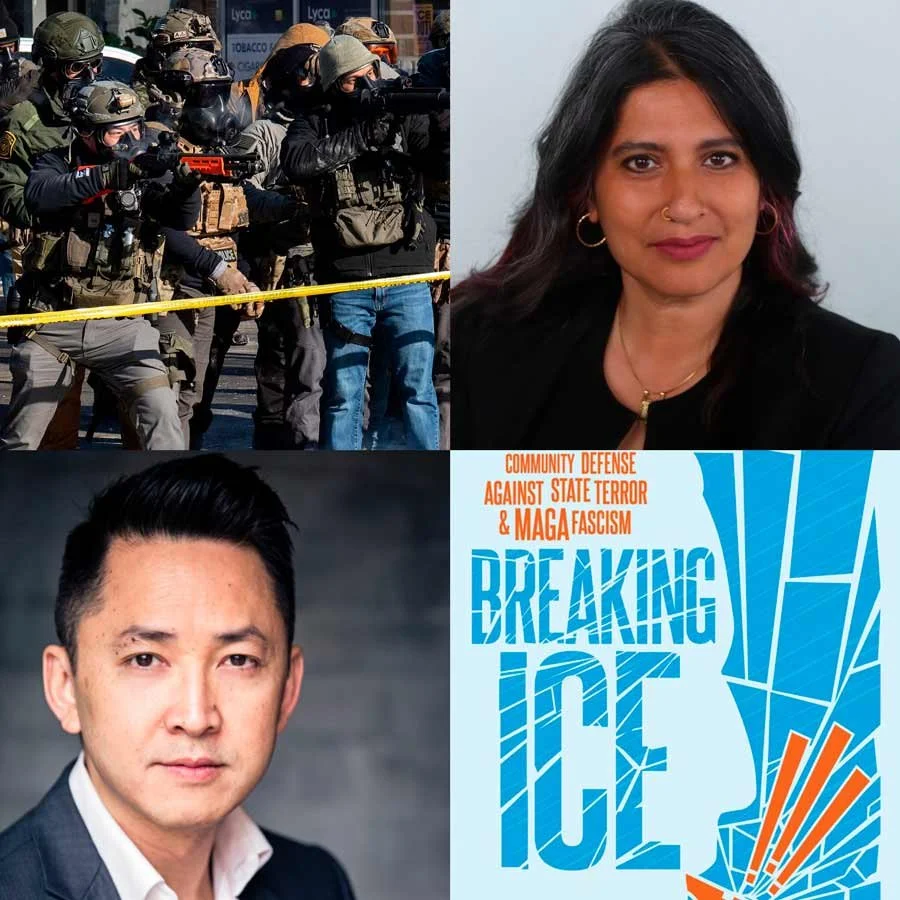


Community Defense Against State Terror and MAGA Fascism with Sonali Kolhatkar and Viet Thanh Nguyen
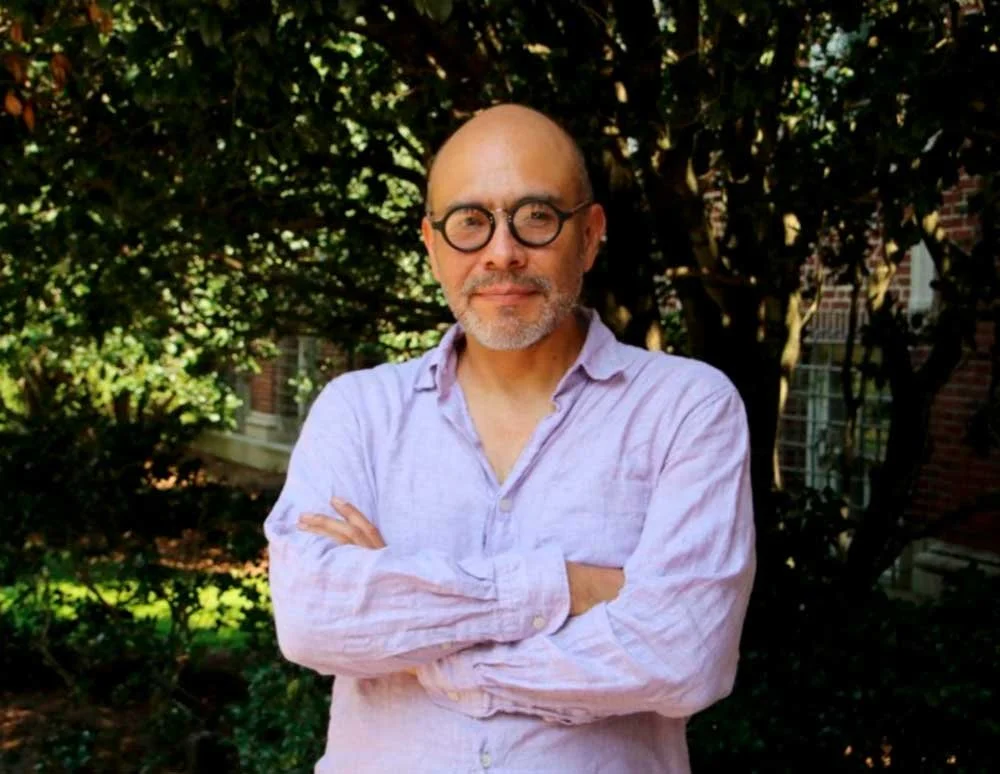
You can see how important storytelling is to fascism and to MAGA and to ICE. Obviously, the construction here is of the United States being invaded by people who are not deserving to be here, culturally and politically for sure, but couched in this language of legalization and who has done the right thing to be here. And that type of narrative is seductive to a whole lot of people, not just white people but to a lot of other people as well, and it's yoked to many other narratives around what is the United States, what is American power, what is going to benefit American power, what's going to erode American power. So there's a tremendous amount of phobia around who constitutes the other or the others to the United States, and it goes way, way back, obviously, to the origins of the country. –Viet Thanh Nguyen
This really is such a thread throughout the book. Solo el pueblo salva al pueblo, only we the people can save the people, has become a theme. Because what happened in 2025 through now is people were realizing, Who's coming to save us? The state is attacking us. When the state is attacking us, who do we turn to? We can only turn to one another. This was really remarkable, and I think it was such an important aspect to showcase because what it did was it gave people confidence. –Sonali Kolhatkar
Speaking Out of Place is produced in collaboration with The Creative Process and is made with support from Stanford University.
In this episode of the Speaking Out of Place podcast, Professor David Palumbo-Liu talks with Sonali Kolhatkar and Viet Thanh Nguyen about a new book edited by Sonali entitled Breaking ICE: Community Defense Against State Terror and MAGA Fascism. The book is comprised of interviews Sonali conducted with activists, organizers, intellectuals and artists from a rich diversity of locations—from Chicago, Los Angeles, Minneapolis, and other major cities, to small towns in Georgia, Maine, the Carolinas, and elsewhere. We talk about the broad ideological formations that support State Terror and Fascism, as well as the ways people have wielded soft power with tactics and strategies such as mutual aid, Know Your Rights, power mapping, networking, and rapid response. Viet specifically talks about the power of counter-narratives that tap into radical imaginings and utopian thinking. We speak of the ways people from all walks of life have risen to the task of keeping each other safe.
DAVID PALUMBO-LIU
Welcome, and thanks so much for being on. This is such a timely and important book, and there's lots to dig into. I think we're all of the same mind that we both want the conceptual ideas out there, but we also want the practical, real-world, on-the-ground stuff foregrounded. So I thought I'd start by asking Sonali, how did this come about? You've been a journalist for so long. You've done so many interviews. How did this all sort of cohere into this particular project?
SONALI KOLHATKAR
I'd been covering the anti-ICE movements, starting in the beginning of the second Trump administration but really ramping up in June of last year when Los Angeles, where I live, was invaded. So I was in downtown LA. I was interviewing people. I was talking to frontline community activists, to the community defense activists who were leading patrols and mutual aid hubs, and it was quite remarkable.
Then the ICE terror spread, and in January of this year when we had the killings of Alex Preti and Rene Goode, I interviewed Yohuru Williams, who's a professor at St. Thomas University in Minnesota, and my longtime editor who works with Seven Stories Press, Gregory Giral, saw that interview and said, “Do you have more?” He saw the transcript of it. He said, “Do you have more interviews like this?” And I said, “Sure, I have plenty, including the one I did with Viet,” and he said, “What if you were to be able to collect a series of interviews, transcripts heavily edited into a book and fast-track it to meet the moment, to meet this incredible moment that we're in where we can get a snapshot of how people confronted ICE and the immigration enforcement apparatus?”
But also putting it into this broader historical context, putting it into the context of the future, into the context of storytelling. So the book came from there, and I had six weeks to put it together.
DAVID PALUMBO-LIU
Oh my God. Yeah. You did it in six weeks. That's incredible. But again, your mind is already working that way. It's been doing that for so long, so it was almost a natural plug-in. And I wanted to also get to the subtitle, State Terror and MAGA Fascism, because I think that really does, again, expand it out in a really interesting way. And so I thought we might now talk about what ICE is exactly, both in real and in concrete matters but also ideologically, and talk about the specific ways of breaking it.
And here is where I thought Viet's essay was particularly useful in this regard because there are two main elements in the interview you guys did where you first talk about this international dimension and this great story about being in San Salvador at the same time as Marco Rubio, which, you know, you just couldn't make up. He's there to sign a treaty. But you also then talk about different forms of soft power. So could you get us started, Viet, by talking about these two different aspects of ICE, the international dimension, the ideological one, its state operations and fascist ideologies, but also how we can break it by ways other than simply direct confrontation, but through storytelling, through different kinds of creative ways of changing the narrative?
VIET THANH NGUYEN
But you can see how important storytelling is to fascism and to MAGA and to ICE and so on. Obviously, the construction here is of the United States being invaded by people who are not deserving to be here, culturally and politically for sure, but couched in this language of legalization and who has done the right thing to be here. And that type of narrative is seductive to a whole lot of people, not just white people but to a lot of other people as well, and it's yoked to many other narratives around what is the United States, what is American power, what is going to benefit American power, what's going to erode American power.
So there's a tremendous amount of phobia around who constitutes the other or the others to the United States, and it goes way, way back, obviously, to the origins of the country. Now, if we look at this specific moment, we see in a really interesting way, of course, there are specific scary bogeymen out there—Venezuelans and Haitians and Salvadorans.
And here, let's just talk specifically about El Salvador and how it, as an example, answers your question, which is if you go to this question of why are Salvadorans dangerous, it goes to this idea that they are gangsters. They have this gang called MS-13 that is like an uber gang, threatens the United States. These people must be deported back to El Salvador, where the president of El Salvador, Bukele, has done a great job, according to Donald Trump and Marco Rubio, in dealing with the gang problem by creating this no-holds-barred mega prison where anybody can be sent on suspicion of being a gang member, and that's all it is, a suspicion of being a gang member.
So there are 80,000 people in this particular prison, at least ten percent of whom, by any safe estimate, are definitely not gang affiliated in any way. But nevertheless, this idea of ruthless law and order is very appealing to the United States, many people and also to, frankly, Salvadorans, who were definitely plagued with a gang problem and tremendous violence, and many people have embraced this kind of solution.
Where did MS-13 come from? MS-13 came from Salvadoran refugees who were fleeing from a civil war-torn El Salvador in the 1970s and 1980s. Why did that civil war happen? For all the reasons you can imagine with the United States intervening in the economics and politics of Central America, which means supporting the domestic oligarchy of El Salvador, which suppressed a lot of people in violent and non-violent ways. And the terrible violence that resulted through US-trained militaries and secret police that killed tens of thousands of Salvadoran civilians generated that refugee flow to the United States.
And here's the last sort of interesting tidbit. Many of these young people arrive in Los Angeles. They do form gangs, but from everything I've heard, these were more like self-defense organizations, the young people in a new environment having to defend themselves. In 1984, the Olympics comes to Los Angeles. The people who organize that don't want any gang problems, so a lot of these youngsters are put into prison. That's where they start to become MS-13, and under the Clinton administration, they start to get deported back to El Salvador, where they then form this really potent violent force.
So deportations, invasions and so on are a feedback loop in the greater Americas. The United States is responsible for a lot of that circulation, but once gangsters actually manifest themselves in the United States, it appears in the American consciousness as if they came out of nowhere instead of coming out of a system in which the United States has a lot of responsibility. So narration is just so important here for us to be able to tell this story about the roots of the violence, who these criminalized people are. There are actual criminals and violent people, but how these narratives of criminalization are done, and of course, how we narrate the power and the violence of the United States as something that is supposed to be legitimate, when in many ways it is oftentimes illegitimate in terms of how multiple Democratic and Republican presidents and administrations have forced American will onto Central and Latin America, producing the very problems that then average Americans have no idea what to do with.
DAVID PALUMBO-LIU
Yeah, absolutely. And I was thinking a lot of the interviews talk about precisely this notion of fear, and that it's not necessarily a direct confrontation, but the insinuation into daily life of not being able to go to work and not being able to hang out here or there or the other place. And so much of the work against that is to dispel that fear through real kinds of associations with human beings. And since we're talking about LA, I love the chapter about MacArthur Park and that invasion, because around that time I interviewed Grupo Autodefensa, who was a very spontaneously built group.
And they talked about, and one of the chapters that you have in the book talks about it as well, a lot of the folks that were fighting the fires in LA then turned around and were threatened with being deported. But in that moment of being part of the community and showing how they were part of it in real human ways, they broke apart that fear factor a lot and showed how people can work together. Could you both talk about how these chapters show, instead of just telling a story that's abstract, people are enacting ways of being together that are more convincing than anything you could say? Maybe give some examples. Yeah. Yeah.
SONALI KOLHATKAR
I'm most excited about the way in which the National Day Laborer Organizing Network has paved the way for many organizations to use a multi-pronged approach to organizing. So I lived in Pasadena with the Pasadena Job Center—just two miles from where the Eaton fire took place—which has been a hub for workers, undocumented workers, to safely get jobs, to have the kind of protections that they lack, labor protections, et cetera. And they knew what was coming with the first Trump administration, and so they were preparing with know your rights trainings.
And before Trump could take office, we had the Eaton fires. People lost homes, lost jobs. And Pablo Alvarado of NDLON, who I interviewed for the book, talks about how immediately these workers who had lost so much pivoted and got to work, right? They did what they could do best. They mobilized these independent efforts to clean up the area, and this is what was really powerful. They didn't just do it because they wanted to be useful, which of course, but they understood the storytelling value of it.
Exactly. Yeah. It's a sophisticated understanding of showing the city of Pasadena and the surrounding Southern California area how valuable they are, and making clear that they are part of this community. They are enmeshed in this community. They have ties here. People are in mixed-status families. NDLON has a band. They have this music band, Los Jornaleros del Norte, where they bring the tradition of their home country and they tell their views on politics through song. And their slogan, which really is such a thread throughout the book, Solo el pueblo salva al pueblo, only we the people can save the people, has become a theme.
Because what happened in 2025 through now is people were realizing, "Who's coming to save us? The state is attacking us. When the state is attacking us, who do we turn to? We can only turn to one another." This was really remarkable, and I think it was such an important aspect to showcase because what it did was it gave people confidence. And Pablo Alvarado talks about fear and fighting the fear and how it was important to turn the tables, that when ICE came calling to say, "Show me your papers," that people had been well-educated in being trained up, and they asked for papers, "Where is your warrant? Has it been signed by a judge?" And untold numbers of people were saved from deportation through that education—through that groundwork that they did.
DAVID PALUMBO-LIU
Yeah. I was thinking too, I did a show with some journalists who were in Springfield during that first wave of attacks, and they pointed out they lived in the city for some time. They pointed out that a lot of the Haitian immigrants actually rebuilt these beautiful old homes that have sort of been neglected, and they invigorated the traditional city, which we often think about immigrants coming and disrupting traditions and the great old times of a bygone era.
But what these people did is they saw what was already there, and they reinvigorated in ways that made people touch back on their own histories with this new set of people. Did you have any other examples of soft power that struck you as being particularly impressive or interesting?
VIET THANH NGUYEN
Yeah, and I think the importance of soft power can't be underestimated, although we can't overestimate it either, especially in the face of hard power…
SHOW FULL INTERVIEW (15:00+) ▼
...The Trump administration has its hands on the levers of real hard power, and it's deeply intimidating and discouraging. However, I do think about the examples of organizing community narratives, grassroots politicization and mobilization that Sonali talks about. I also think about different levels of soft power narration that occur. Sometimes the soft power narratives are occurring at high elite levels, like novels and movies like that, or pundits for The New York Times, and that is crucial too.
Although the longer it takes to make these things, the slower their response time is. So you can write a novel as fast as you can, but it's still going to take a year or two years for even the fastest novel to get out there or a movie to address these kinds of issues, as important as those are. But meanwhile, people are mobilizing and telling soft power narratives through the media they have at hand, and here you have the mixed message of what social media can do. Social media has all kinds of pernicious aspects, but I don't think there's any doubt that social media in the form of phones, in the form of Instagram or TikTok and Twitter and so on, has been able to amplify and broadcast certain kinds of images that do humanize people, that do give these stories a face and a voice and names and so on.
This is evident everywhere from the genocide in Gaza to what's happening on a regular basis to Black people in the United States, like the Nolan Wells case, for example, which became an issue at least partly because people were amplifying it via social media. So here when we talk about ICE and deportations and so on, the fact of the accumulation of various kinds of terrible graphic videos, the accumulation of individual stories of people who've been subjected to various kinds of detention and expulsion and so on, or exile to these remote countries, those things one-on-one may not count for much, but I think the accumulation does have meaning—does have force to try to persuade people that these are human beings.
Now, a lot of the people who are getting these messages are already inclined to see immigrants as human beings, so they're already the choir that's being preached to. But if we look at polling numbers as one evidence of just a measurement of the mood of the American public, I don't think there's any doubt that there has been an effect on Middle America. Now, that means that there's also probably a portion of the United States, I don't know what that number is, maybe 20 to 40 percent of people who will be unmoved regardless of any kinds of stories that they're getting. But we're playing politics, so every inch counts in this particular struggle. And so I think every form of soft power narration that gives a face, a name and a story does matter.
Yeah. I'm leaping way ahead because this is something I was going to leave until the end, but it's the opportune moment now. It's this quote from Christine Neumann-Ortiz. And she says, "It's not just about immigrant rights, it's also about democracy." And probably the softest form of power that I've seen, I just noted this morning, but Texas, these boards of supervisors are screwing around and shutting down polling places and making people drive two hours to get to them, and people are just outraged.
They see it as such a transparent tactic that there are these town halls with the supervisors, and I think there's three of them. And so people are lining up down the block to get their one minute, and this one guy gets up, and he's looking at one of the supervisors and said, "How can you do this?" And the guy looks down. He says, "I want you to look me in the face." And the guy says, "You can use your one minute any way you want." He said, "I'm going to sit here and wait my whole minute waiting for you to look me in the face."
And that just went viral, right? That was such a minimalist moment of just not backing down and just saying, "We are here to be reckoned with." And that spread, and that then went to things very similar to what we see in this collection of people saying, "Okay, we'll drive you ten miles this way to the next polling place. We're going to be knocking on doors, making sure people understand their polling place has been moved, but there are other ways to do it."
So that's one thing in Texas. I talked about the thing in Springfield, and the thing that I really was also very impressed by in the book is the geographic reach, Sonali. You went to all these places, and one of the places that I was most struck by was Maine, right? But you also went to Georgia. It'd be interesting if you could both talk a little bit about some of the stories coming out, not from LA or Chicago or Minneapolis, but from some places that are not known for long traditions of radical, you know, politics.
I think it's important to give a little bit of context because the immigrants are enmeshed not just in urban centers in the United States today. You can go to rural states, and there are immigrants who are filling the jobs that native-born people haven't been able to fill, right? And one of the things that I do in my introduction to the book is I trace how the September 11th attacks first provided the justification for the USA Patriot Act and then the formation of the Department of Homeland Security and this language around homeland, who belongs in the homeland, who doesn't, and the formation of ICE.
But what also came around that time was in 2000, you had the census that showed the largest jump in the foreign-born population in the United States in modern history, and this scared members of Congress and there was a big to-do about it because people were using the pathways at their means. They were using student visas to come into universities like I did in 1991. They were using work visas. They were using all manner of legal forms and legal pathways of immigration, and there was also undocumented crossing the border, visa overstays, as there always has been.
But the census counted this, and it sent the white supremacists into a panic, and that's when you had the attempt to pass the Sensenbrenner bill, and people showed up and spoke out, and there were these million people in LA marched against it. But this demographic shift is precisely what the MAGA crowd has been fighting against, and it's not just the MAGA crowd. They're the sort of culmination of it. But even Democratic presidents have talked about... This is when they really changed the language, and it's not the first time they changed the language.
We've had the pendulum swinging back and forth. But in the modern era, this was the moment that you can see the language changing from immigration violations being civil infractions to them being illegals, quote, unquote, and it still didn't stem the tide. So people still were coming, diversifying the nation, and working in the whitest state in the nation, Maine, to Wisconsin to Georgia to all parts of the country where you didn't traditionally see non-white immigrants. Yeah. And so I thought it was really important.
In Georgia, the case where they had this huge raid of Korean workers who were basically working, I think it was a Hyundai plant that were working with papers, that were working to set up a plant that would give jobs to Americans, and ICE was called, and they rounded up these workers. There were Latin American workers among them as well, and they were like, "No, I have papers," and they were still arrested and detained and deported. And so I thought it was really important to showcase how people were mobilizing. Community defense in a place like North Carolina is very different from Chicago or from Los Angeles. Sometimes just by virtue of geography, places are spread out. Also, there's a lot of snow and ice in the winter.
In places like Minneapolis, you had a very small city with a small overall population, and the amount of ICE agents that were sent there was so outsized, so disproportionate in a small geographic place with a small population, that you got this incredible response to it. So everywhere that there was ICE and where there was community defense against ICE looked slightly different with some common threads, and I wanted to capture that. Because, of course, what's happened between even just March of this year and now is ICE has changed its tactics. Once Kristi Noem left, Markwayne Mullin came in, the new head of DHS, and decided that it wasn't helpful to have the Hollywood-style invasions that helped mobilize people, so he's doing it more quietly. They're deporting more people now, and people are having to react and organize in very different ways than they were doing just a few months ago.
I think there's also, besides the act of deliberate resistance, which is important, and the act of self-conscious narration, which is important. I'm looking at a book right now called American Occupation: Dispatches from Minnesota's Resistance to ICE, coming out of University of Minnesota Press. So that would be an example of a more elite kind of publication. But everybody who's publishing in here, there's dozens and dozens of people, most of them are not professional writers. They've congregated around writing these short passages about what they've been through, what they've witnessed.
But there's another genre, which is the genre of the person who didn't think they were going to be deported, the person who didn't think they were going to be arrested. And this, I would not discredit this genre. I think there's a certain amount of schadenfreude or gloating on the part of liberals or the left. "Oh, wow, you didn't think the leopard would eat your face." Okay, we can take a little bit of recognition of that. But at the same time, there's more and more of these kinds of stories, everything from Milo Yiannopoulos being deported in a very funny way. Hopefully he'll write a novel or make a movie about this someday. I think it would be great.
But there's also many other examples of everyday people who have been deported from all different parts of the country. I'm also looking at a story about a woman named Melissa Tran last year from Maryland, who was a nail salon owner and had committed some violations in the past and was then arrested by ICE, and her community, probably not an incredibly progressive community, came around to support her. Now, the more that these kinds of things happen and the more they're talked about, which is actually happening, I think there is an impact on the general American consciousness.
And the amplification of these kinds of stories has not taken place in other kinds of even more authoritarian societies. So at least these kinds of things are making the news. And again, we're in a battle, electorally speaking, for a handful of votes, for a small percentage of people. And so when we speak again about the persuadable part of the United States, it's exactly these kinds of people who didn't think that deportation would come for them. And I'm hoping that the accumulation of such stories will also move the needle in its own way, and we need every single movement we can get.
Yeah. No, I'd love to ask both of you exactly that question. I don't get around that much anymore, but especially, Viet, you've been to so many different communities globally, and also Sonali, I know you traveled a lot too. Do you think people are starting to connect the dots? Because what one hears now is the economy is just completely tanking and we're $40 trillion in debt. And so that's often people's most immediate contact point. They can't pay their groceries. But are they putting it together with the idea of the war in Iran, the war in Gaza, the constant expenditure of public money into private benefit? Do you think people are beginning to understand from their pocketbooks into these larger structures that we understand as being fascistic and authoritarian? Is that just me being optimistic?
I think they do understand the direct impacts. Because of the United States' heavy reliance and heavy centrality around individualism and this notion that we are a go-it-alone country, until things impact us individually, we tend to not have the kind of empathy that in other countries, maybe with a more collectivist culture might extend. We tend to, like Milo Yiannopoulos, care about deportation and its cruelty when it hurts us or when our Venezuelan fiancé gets carted off. But it is hurting people in the pocketbook, and public opinion polls are showing the Iran war is deeply unpopular. Trump himself is deeply unpopular. The tide has shifted on immigration dramatically.
In 2024, when Trump was talking about mass deportation, you saw a rise in support for immigration enforcement. One year later, that had dropped. A year after that, it's dropped even more because he overplayed his hand. And sad that we have to rely on him overplaying his hand, but I think that people are seeing the impacts. As to whether they're making the connections and seeing a big picture, I'm not so optimistic, and I think in large part because it is up to journalists, writers, political pundits, newspapers and news media to try to make those connections, and they just don't do a good job anymore, in large part because billionaires realize how important, useful and effective narrative is, and so they have bought up platforms.
They've bought up everything from X to TikTok to The Washington Post and even The Atlantic. You're seeing the most reactionary kind of storytelling in these liberal outlets—once liberal outlets—than you do today. And so if those connections were made more explicit, I think we would see a larger upswell, which is why I'm super biased. I think independent journalism is so important for that reason, and it's also why people seek out those independent sources of information because they know that there's something not quite right, and so they seek out. Unfortunately, there's also a lot of hyperbole online, so it's easy to go down a rabbit hole, and we have to develop strong radars to have that media literacy, which hopefully... I think young people are a little savvier now. And now with the advent of AI, it's even harder to tell what's real and what's not.
Yeah. I'd love to get Viet's thoughts on this, but with an extra sort of dimension because again, the story of you and Marco Rubio in San Salvador, and I'm thinking about immigrant communities are not homogeneous by any means. When you think about the Cuban community, some very conservative, and think the Vietnamese community also, how do these different communities that have complex histories ideologically, how are they working out these issues?
I don't know if they're working out these issues any differently than the rest of the United States. I think every portion of the United States has been divided, and I think that's actually important to stress, that there's not a homogeneity across different populations, and that makes political analysis and political mobilization harder, but it also provides more hope. So, for example, I do travel to a lot of different parts of the country like Sonali does, and my work takes me as a speaker oftentimes to red states, but I go to the blue parts of red states. And that is actually hopeful that, again, even red states are not homogenous, just as blue states are not homogenous, and that means that there is a possibility of speaking to people in red states and finding these substantial populations of people who are progressive or liberal or Democrat or what have you.
And likewise, with any particular ethnic or national community, whether it's Cuban or Vietnamese, I think the narrative that they are inevitably conservative is partly wrong. I take hope in the fact that historically, for example, with the Vietnamese American community, it has been dominated by anti-communist voices, but you have a younger generation of Vietnamese Americans who are not only progressive and liberal, some of them are just outright Marxist and communist. It's unheard of. There are people from Little Saigon on social media, young people proclaiming, "I'm actually a Marxist or a communist." Now, they're doing it anonymously, but they're still saying it. So there's actually much more diversity in these communities than we might give people credit for.
Now, that doesn't mean that the fact that Cuban Americans, for example, have been historically captured by anti-communism is not something that we should ignore. But it does point to how the kind of politics that we have to engage in has to be a politics of solidarity that reaches out across these boundaries of state or of ethnicity, and with the recognition that we need to build sort of this broad-based, multi-ethnic coalition.
And that is a challenge I think that we're facing, and I don't think that the average American is probably thinking Trump is a fascist or an authoritarian. They're probably not using that kind of language. But Trump's strength and weakness is that he has claimed this prerogative for himself of being the strongman who everything depends on. So therefore, if he can claim all the success, he has to claim all the failures as well. And I think people do understand that.
I don't know if they're necessarily connecting the dots, but they do understand that he is responsible for everything. So whether they like what he's doing in immigration or not, they can't separate that from the entire package, which means failure in Iran or the failure of the economy and the spectacles of corruption that are taking place.
So that is something that I think needs to be pressed on, and the thing that I fear most is actually not the average American person. The thing I fear most is the Democratic Party not being able to offer a substantial counter-narrative that would be populist and radically democratic, but instead relying on more of the same kind of safe corporate liberalism that got Democrats into trouble in the first place.
Now that's a great point because it leads me to the big question is how, and there's no single answer, but what ways can we break ICE? And let's start with the Democratic Party, because right now we're going into this election, and there's all this enthusiasm about a blue wave, but I'm hugely skeptical about that for any number of different reasons. But how do you see electoral politics playing a role in breaking ICE versus any number of other things we might get to later on?
I think I'm troubled by the way in which some members of the progressive wing of the Democratic Party are backpedaling from some of the very values that they once claimed. I'm very specifically thinking of AOC, who has now, I guess, has her eye on the presidency, and so her saying, "Woke one was crazy," which was a very bizarre way to say that, "Oh, I think we were wrong when we were calling for the defunding of police."
I think Democrats, including progressive Democrats, really dropped the ball on this moment, and to me, it speaks of the virulent anti-Blackness in our country and our society. Because there is general agreement around the need to abolish ICE, which is understandable given that ICE is only 25 years old, but it's not like ICE came out of nowhere. Before ICE, there was La Migra, which was INS, right? And I think what they're saying when they say abolish ICE is let's go back to the INS or that formation.
But really what they're also saying is that there's a difference between ICE and police. Is there really? Yes, there are some technical differences. Police are city forces, and ICE is a federal police force, but they're both police forces, and they terrorize many communities of color, and those people who have been terrorized by police, who were calling in 2020 to defund the police, had a huge multiracial support, and for a moment were seen and heard, and then you had Biden coming in immediately saying, "No, no, no, no, no.
I support the police. I would never talk about defunding the police." You saw all this backpedaling, and those issues were swept under the rug as if police stopped killing Black people. They did not. They are continuing to kill them. They're continuing to kill unarmed Americans in higher and higher numbers every year, and it is the same kind of thing that is happening at a federal level.
We're seeing money being taken out of the things that truly keep us safe, right? Like healthcare, Medicare, Medicaid and food stamps, and pouring it into enforcement, into armed thugs, which is what happens at the city level. We have money that gets diverted into policing and away from the things that really keep us safe: housing, employment and education. The biggest predictor of crime is inequality. And so this is where I think Democrats could really hone in on the issues that don't just impact people of color but all Americans.
Don't just tell us how you're going to take on Trump and return things to the way they were, claiming that returning things to the way they were was what got you election losses to begin with. Tell us about the future that you want to promise to us. Tell us how you're going to build a better world, right? Take a page out of Mamdani's book, right? People immediately know what he stood for. He stands for city-run grocery stores and universal childcare. He won, and he is so universally popular. It's not that hard.
So if Democrats were to do that, it would go a long way, and I really want voters to change their dynamic as well. Stop with the, "I'm with her, I'm with them, who am I going to back?" That is not politics. Politics is, "Who is going to back me? This is what I want. I want an affordable lifestyle. I want to be able to send my kids to school, not go into debt. Who is going to deliver those things to me?" And maybe they'll get my vote this time around, and if they don't keep their promises, they won't get it next time around. An election is a job interview, it's not a popularity contest, right? So I want Democrats to get that lesson. I don't know if they will.
I actually don't have anything to add to that. I think Sonali captured it in a whole move. I think there is an issue, though, that politics is about strategy, it's about narration and so on, but it's also balanced, again, with authenticity. Whether the authenticity is real or manufactured remains to be seen, but so far we're not seeing a great degree of that sort of populist authenticity that's necessary.
Yeah. Let's maybe turn to the international stage a little bit because I don't know if you know about this hearing that took place in the Inter-American Court. It was brought by the University Network on Human Rights, which is an interesting organization that was started by a guy named Jim Cavallaro. He used to be the Human Rights Clinic director at Harvard, then he came to Stanford, and he's been very energetic about mobilizing youth in terms of human rights in a rather radical kind of way. He was also a former chief justice of that court, and then Biden refused to endorse him again, so he was scuttled out because of his position on Palestine.
But they brought a case against the United States and ICE in the Inter-American Court, and it happened just last month, and it was really an interesting event, and we're going to have him on the program soon to talk about it, and I think these two episodes work really well together. They had on their panel the attorneys for Rene Goode, they had the pastor who was shot in the head by that bullet. They had a lot of top-rank experts laying out the case against ICE and the Department of Homeland Security for its egregious violations of constitutional rights and whatever.
And then the United States was represented by the usual kind of bureaucrat who just said, "We cannot comment on anything you've said because they have to do with active cases," right? And then Jim said, "This is not a hearing. This is a testimony. We just want to put this into the public record and want your reaction." And so it was like oil and water with the state doing the usual evasive movements of let's just kick it down the road until it disappears, and then this groundswell of really important testimony and the court itself asking for more and more information.
So I'm wondering if we could turn a little bit now to the nexus between hard and soft power, right? Where can there be some movement when we not only talk about civil society, but we talk about global civil society and talk about the fact that these attacks on immigrants and refugees are, of course, taking place all over the world. How do you see these kinds of things happening in the same way as we talked about Maine, Georgia and Minnesota, and then Los Angeles and Chicago? There's no global movement, of course, but how can we learn from these different kinds of pressure points perhaps, and amplify the message by saying there are similar things happening elsewhere, and we can cross-reference in certain ways?
I'll let Viet go first because I think I spoke too much before, but this is, I think, also something that you write more effectively about.
Well, I think it's interesting about the idea of taking the United States to court. I was thinking specifically of Malcolm X taking the case of African American civil rights to the UN as a case of global human rights. And at that time, he was investing in this belief in such a thing as the United Nations and such a thing as international law. And of course, now we are at a moment where those very ideas are being contested, first and foremost through this question of whether there is a genocide in Gaza and whether anybody can be held accountable, including nation states from Israel to the United States.
And you would see why the Trump administration would want to burn down these kinds of institutions. So I think that is a good example of trying to both affirm some kind of international legal standard while also trying to hold the United States accountable. And I think the Trump administration's response to that would be really fairly predictable. But the other dimension of hard power is not just legal contestation, but is also hard power in terms of nation-state conflict as well. Now, here we're seeing nation-state conflict at the level of armed conflict, war with Iran, Hamas being a force of resistance and other nation states from China to Brazil trying to form alternative economic configurations.
Now, these kinds of movements are outside of the control of so many of us within the United States, but I think we also have to recognize that anything that happens domestically in the US is also happening in relationship to the United States as a global power in these other kinds of arenas. And when we think about our domestic politics, how do we think about those in relationship to international politics as well? That has always been an extremely sensitive boundary. We see that in any kind of moment of war. For example, with the Vietnam War, should Black civil rights leaders focus only on Black civil rights in the United States, or should they also recognize the connection with what's happening globally?
That was the choice that Martin Luther King Jr. made in his speech Beyond Vietnam. James Baldwin gradually also got radicalized in that direction, was able to make connections between what was happening in the United States with Black people, with what was happening in Southeast Asia and with what was happening in Palestine. He very explicitly said, "I'm going to side with the Arabs versus the Israelis," in his book, No Name in the Street.
So I think that we need to take lessons from the past because we're in these moments of cyclical contradiction rather than linear narrative. So much of what is happening today is a repetition of what has happened in the past, and so we're faced with many of the same choices today. If our politics domestically are going to be purely domestic in our narratives, we're missing actually half the picture. But so much of what is happening in the United States is not simply the Trump administration or Democrats responding to domestic issues, but how they're responding to domestic issues as they're linked to the international as well.
And so I think a truly radical and progressive politics would be able to make those kinds of linkages and speak urgently about things like deportation and immigration, while also talking about how those are related to these larger geopolitical problems and competitions that are happening around questions of power and resources and the environment and so on. And that's really what's required for a visionary politics, whether it's a visionary politics for the grassroots or whether it's a visionary politics that we expect from anybody trying to compete for an electoral office.
I would love to add to that. The interview that I did with Ibram X. Kendi that's in the book really shows how international the attacks, the authoritarian wave has become, and they are coordinating with one another, right? These fascist leaders are openly having conferences and meetings, and he shows how these ideas are rooted in history. And I think our response to that can be fairly simple because there is a powerful counter.
What most people want, whether they're Americans, white MAGA people living in rural America or whether they're Salvadorans, et cetera, is safety, right? They want safety, security, they want to be able to thrive and they want places for their children to be able to thrive. And if we talk in those terms, we can easily say, "What are the things that keep us truly safe?" So just as I was saying earlier, building on this abolitionist framework of divesting from policing, divesting from armed thuggery, divesting from armed militarism, militarism in general, and investing in the things that keep us safe, right?
If we care about immigration and people crossing borders, what would keep people safe in their own homes, right? Preventing it from happening in the first place is much more effective than having this crackdown on the other end and hurting people. And so what would help people thrive in their own homes? It's the same things that help us thrive in our own homes. So having that framework, that narrative, these abolitionist ideals apply from the global down to the local level can be a really effective way to counter the pouring of our collective resources into weaponry and into savagery and diverting them into the things that keep us safe.
And that allows us to, through that framework, talk about taxing billionaires more, reducing militarism and reducing weaponry and ending wars. That can be a unifying framework, and I talk about that in my previous book, talking about abolition, A Police-Free World is Possible. And it's also why in this book there are so many Black abolitionists that I interviewed, like Robin D.G. Kelley and many other folks who have really laid out for us the simple frameworks that we can use soft power narrative to counteract hard power, and also make connections across the political spectrum with people who we don't agree on everything with. And I think there's a lot of potential there to move forward, to move the needle.
No, I agree completely, and I also think that especially, you know, we're beginning the new school year and there will be a new crop of first-year students, and I think that the world they lived through has been just catastrophic with COVID and Trump and all this. And I think they are also filled with a great deal of energy to fight this. In other words, they don't want this kind of world anymore. And I think in general, the population in the US is just exhausted by the violence.
We've been buffeted by one wave of violence of one sort after another. And I think at a certain moment, there's a kind of breaking point, and people are seeing exactly what you mentioned, Sonali. This is not the way life is supposed to be, right? And we are looking for ways to reinvigorate a positive vision, and I think that this book shows us so many examples of the mutual aid, the different ways of coming together, the ways of conviviality and showing how life can be in small ways that isn't bombastic and dramatic, but it's just real...
.CLOSING THOUGHTS (45:00+)
The other thing that really comes through in all these stories is it's not forced, it's not overly political. It's just being together in ways that are decent. We should not downplay the small words like decency and modesty and care. Do either of you have anything else you'd like to add? I know that we have to wrap up soon, but I'm just so happy that you're both here and so grateful, but I'd like to give you both a chance to wrap up any way you'd like.
I think about this on a regular basis, about how these things have happened before in American history, and about how when we look back on American history, it's shocking to think about how certain things like the deportation of two million people during the 1930s back to Mexico, when we think about those numbers, I wonder, how did it happen? How did this take place? And what were the reactions of everyday Americans?
And then when we see numbers like ICE is now arresting something like 50,000 people a month, then we start to understand how these structures of power can be built, can be resurrected. But we also understand perhaps how they've been deconstructed or taken apart at the same time. And so when I mentioned earlier that history moves in cycles rather than in a linear narrative, in some ways it's depressing because you think, "Wow, we thought we defeated the evils in the past, but now the evils are coming back." But I think the point here in terms of optimism is the sense that there was victory in the past. Victory is possible even against overwhelming odds.
And we have to balance this kind of realist understanding of how enduring evil and power happen to be with also how enduring human resistance is and how enduring certain human notions are about fairness and justice and the safety that Sonali brought up that we can turn to. So I take hope in these things, a measured kind of hope that has always driven people. Not the hope of Obama, which is premised upon what I think are sentimental notions of the United States, but the hope of the activists who have always fought, the hope of the grassroots organizers, the hope of the writers and the outcasts and the misfits. And not everybody is an outcast or a misfit in the United States. A lot of people want to be in the mainstream, they want to be average, but there have been these moments of convergence where the outsiders and the outcasts have joined forces with the mainstream, and I hope we're on the brink of that happening again as well.
Sonali, you get the last word.
I hope people grab this book and be inspired by it and see it as something to build on because it captures a moment in time, but it also tries to put that in a historical context, and it's already shifted, right? The tactics have shifted. So how do we respond? And people are responding in different ways. And I also want people to think about how we support one another, the communities that we build with each other.
So picking up on what you were saying about human decency, right? Ultimately, we're living in a moment of great uncertainty, not just through political means but climate change, right? I remember when the Eaton fires destroyed a community right near me, and I knew more than 30 families who lost homes personally. And what did my family do? We relied on the network of neighbors that were living around us who we already had formed ties with because of COVID.
COVID pushed us together to lean on one another, and we were able to coordinate. We were able to share resources. We were able to mobilize rapidly. We were able to keep each other safe. One of my neighbors offered to run and pick up my dad's meds that he had forgotten after we evacuated. And then when the fires had died down, we commiserated together. We held each other and felt safe and happy that we had survived and that our homes had survived.
That is the kind of network that people have drawn upon in this past year around the ICE raids as well. That is what we're going to need more and more of. And isolation, what capitalism breeds in us, right? Our current economic system wants us to be isolated. They want us to be staring at our phones, doomscrolling all day, and not really thinking about how we're connected to each other in real life and in person. Because then we wouldn't be as good consumers.
We wouldn't spend all our money where they want us to. And so I think just building that community and feeling strong in that community and really seeing our neighbors as part of our extended family, which is the best counter to authoritarianism, to capitalism and to the notion of individualism that has really troubled this country from its start, is one of the best things that we can do as the most basic first step. Because then when they cart your neighbor away, you are not going to stand for it, because that is your friend. That is someone you've relied on.
I want to thank you both for being on the show and for this amazing book, and I urge everybody listening to buy the book, read it, share it, because it has just a incredible diversity and multiplicity of real life stories of people doing exactly what Sonali and Viet have been talking about, and I share both of your cautious hopes. And so thank you again for spending time with us.