

When we look at police brutality, when we look at violent conditions, you can't break a cycle of violence with more violence. And the prison is, if not the most profound and devastating state sanctioned and institutional expression of violence, it is a violence incubator.
Speaking Out of Place is produced in collaboration with The Creative Process and is made with support from Stanford University.
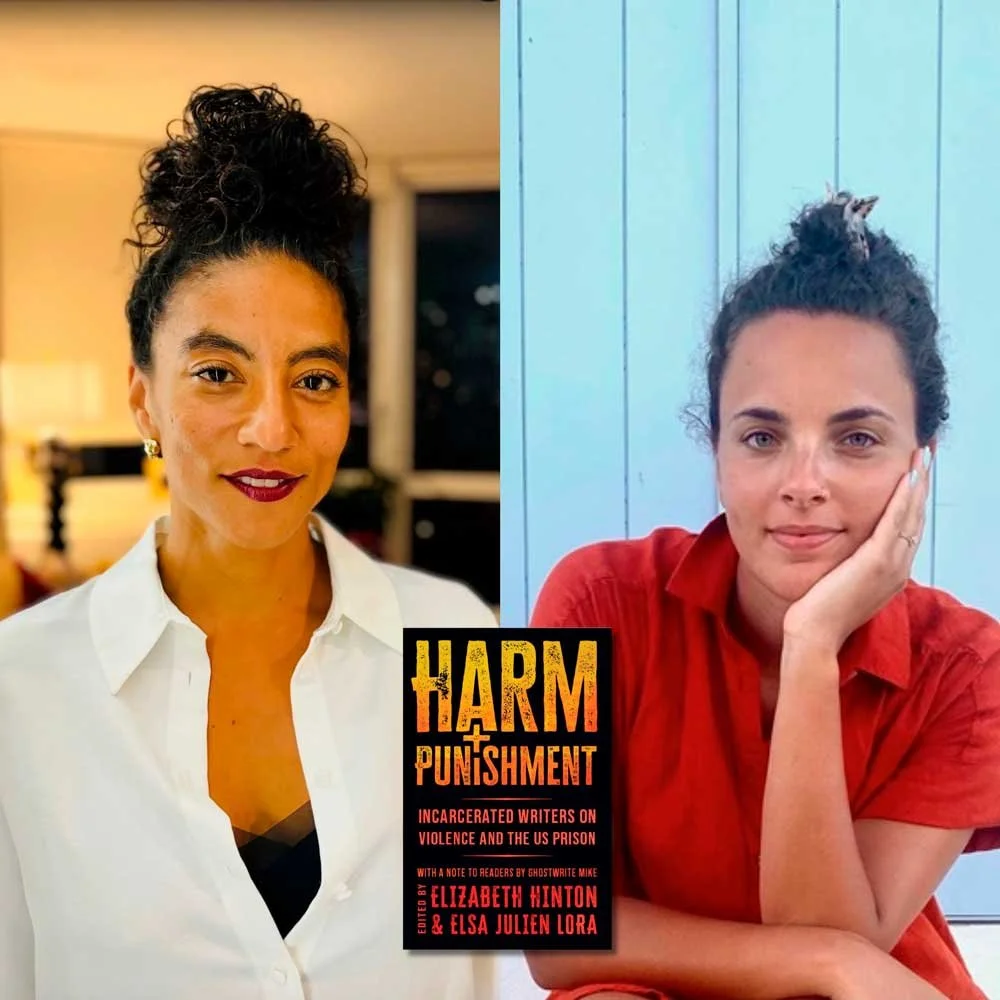
In this episode of the Speaking Out of Place podcast, Professor David Palumbo-Liu talks with Elizabeth Hinton and Elsa Julien Lora about their new book, Harm and Punishment: Incarcerated Writers on Violence and the US Prison. Along with two research assistants, Lora and Hinton pored over hundreds of essays by prisoners, found in the American Prison Writing Archive. They then selected and organized the essays found in this volume, offering illuminating introductions to each section.
Our discussion moves through many topics—the brutal, dehumanizing, and punitive nature of the prison system, the damage it does to lives both inside and outside prison, and the ways prisoners find to survive and offer each other support, despite being pitted against each other. At base, we consider how we, as a society, are “addicted to violence,” and why and how it is crucial to understand that violence can only produce more violence. These essays organically blend personal observations and stories with a deep understanding of the broad, systemic nature of violence.
Elizabeth Hinton is one of the nation’s leading experts on the roots of mass incarceration and enduring inequality in the United States. The Class of 1954 Professor of History, Black Studies, and Law at Yale University, Hinton serves as the founding director of the Justice for Everybody Movement J4EM, a university-based center focused on promoting public safety through education, research, and coalition-building. At Harvard, she is the founding co-director (with Brandon M. Terry) of the Hutchins Center’s Institute on Policing, Incarceration, and Public Safety.
Hinton’s groundbreaking books—From the War on Poverty to the War on Crime and America on Fire—were each named New York Times Notable Books and have become essential texts in policy and social justice circles. A sought-after public intellectual, Hinton’s commentary appears in The New York Times, The Washington Post, The Atlantic, New York Magazine, The Los Angeles Times and beyond. Her research has been supported by the Carnegie Corporation and the Guggenheim, Mellon, and Ford Foundations. Hinton served on the National Academies of Sciences Committee on Reducing Racial Inequalities in the Criminal Justice System and in 2022 was elected to the American Philosophical Society as one of the youngest members in its history. At J4EM, Hinton is building the infrastructure for a more just and robust democracy—where education is not a privilege, but a cornerstone of public safety.
Elsa Julien Lora is a U.S. historian and interdisciplinary scholar whose research focuses on the history of American prisons and the texture and intimacy of family life. A Postdoctoral Research Fellow at the Columbia University Society of Fellows, Elsa is at work on her book, Life in Prison: An Intimate History of American Punishment. Her research has been supported by the Mellon Foundation, the American Council of Learned Societies, the Institute for Citizens and Scholars, and the American Society for Legal History. Elsa’s writing about race, justice, and family has appeared in the Virginia Quarterly Review, Aperture, and Public Books, and she is currently producing a documentary about her grandmother, boundary-breaking modern dancer Mary Hinkson. She holds a PhD in African and African American Studies from Harvard University and a JD from Yale Law School.
DAVID PALUMBO-LIU
Thank you so much for being on the podcast and especially for this remarkable and quite unique book. I thought maybe I could begin, oddly, by reading part of your postscript, which I think ties things together beautifully. I'm just going to read some excerpts and then ask you about it. You write:
The essays in this collection seek to answer a simple question: What work do prisons actually do? The incarcerated authors featured in this volume describe violence as a deeply contextual phenomenon shaped by historical trauma, cycles of deprivation and socioeconomic inequities.
Linking the personal to the structural, they trace the way material violence often emerges within communities affected by poverty, racism, sexism, homophobia, transphobia—all of which are forms of violence. And in so doing, they insist that violence, whether it happens within or outside the prison, must be understood in relational and systemic terms rather than in individualistic or moralistic tones.
I just want to add that I really appreciate how well you blend exactly the personal and the structural because it'd be easy to let one dominate the other for whatever point you want to make. And remarkably, the writers themselves do this. They are in touch with this. And I want to ask you, what were some of the biggest challenges you had going into this and also the rewards?
ELSA JULIEN LORA
I think probably the biggest challenge was an organizational one. We culled hundreds of essays over the course of a summer with the help of two undergraduate research assistants. The essays are derived from the American Prison Writing Archive, which is the largest digital collection of writings by incarcerated people. I think there's about 4,500 essays in the collection right now and it's always growing and it has a very sophisticated search tool.
The undergraduate research assistants helped us think through what search terms to put in. This isn't a very interesting or sexy part of writing a book, but that was really how it started. And we started just by searching the term violence and got over 500 essays from that search and realized that was telling a very provocative but particular story.
And when we started experimenting with other search terms that were seemingly really unrelated to the topic of violence, those essays were also really talking about violence. So the first challenge was just we have so many essays, more essays than we could possibly publish in ten anthologies. And then the second challenge, once we started to narrow down which essays we wanted to include, which was also shaped by which essays we had permission to include, was how do we begin to organize them?
And I think it was through the process of ideating about them, we came to recognize this dynamic that you're describing, where we're blending the personal and the structural and showing how they co-constitute each other. That wasn't an idea that we had coming into the project. It was an idea that the essays demanded that we take seriously and try to unfold and make explicit.
ELIZABETH HINTON
Another challenge that we faced, and this is just more of a personal one about the process of editing this, was the material is extremely heavy. It's really tough. It's enraging. It's devastating. It's sad. I think that we found ourselves having to take breaks.
So it's not like we could just read through 500 of these essays. You might read one and then just need to put it down for a bit. And I think the process of putting the volume together and selecting which ones we would eventually use and which excerpts from other essays that we would use helped with that. But it was a very difficult... This is the heaviest material I've probably worked with, the heaviest archive in total that I've worked with, and that to me was a big challenge in writing it.
And then thinking about how do we create a volume that really centers and amplifies the voices of the contributors that helps raise awareness, mobilize people and activate people around the violence that is the US prison system, but while also giving people some kind of hope, something to hold on to, some sense of the way that the contributors, but by implication, people historically who are living under oppression, find freedom within that and also resist and fight back.
DAVID PALUMBO-LIU
One of my later questions will be precisely the way you arrange the stories because there's a really interesting arc that leaves one with hope. I guess that's also an inflated word in this context, I think. But I was interested in what you both said. I found myself pacing myself very slowly because all these stories demand and deserve to be looked at carefully.
But our tendency as a culture is to brush past things, right? Just fit it into a stereotype, say, that's this, and tie it up with a label and move on. But the stories are so gripping that they hold you in suspension and they deserve to be looked at and looked at over and over again. We'll get more into that as well.
I picked up on this line from “Dogma” by Justin Surdyka: violence can only produce more violence. And that riveting story, the attention to the wax on the hallway and the way he builds up from that to all these elements in this really confined space, I thought was really interesting. And another line that popped out in conversation with that almost was from another story that used the expression “addicted to violence.”
And a while back, I had Victoria Law on to talk about Corridors of Contagion, and you know that book is remarkable for so many things, but one thing she brings out is that when COVID hits, the prisons actually got more brutal, right? Some countries were reasonable and they let prisoners out, but the United States doubled down.
And this to me shows that the addiction to violence is pathological. Could you talk about this addiction, both of you? And I was thinking the story “The Tear” really shows how methodical the violence is, but I would love to get both of your reactions to just the general idea of violence and its pervasiveness.
ELIZABETH HINTON
Yeah. We kind of came to this topic because in my work especially, I'm trying to think about violence and how to understand it, how to historicize violence. I'm a historian, and so is Elsa, and we haven't done a very good job of trying to really take violence seriously as a subject of historical consideration the way that geographers, criminologists, sociologists and anthropologists have, and try to contextualize and lend greater understanding.
One of the things that I, coming into the volume, exactly what Justin says about violence. Yeah. Violence precipitates violence.
When we look at police brutality, when we look at violent conditions, you can't break a cycle of violence with more violence. And the prison is, if not the most profound and devastating state-sanctioned and institutional expression of violence, it is a violence incubator.
And these are ideas that we had coming into the curation and editing process, but the essays themselves spoke even more to that. And I think one of the things that underscored it more, as Elsa was saying, as we expanded the search to include things like family and all different kinds of search terms that we use, you begin to see the way that violence appears and how it manifests in material conditions and how conditions are violent. And that was one of the things that we really wanted to show.
And a running theme in almost every submission that we read, many of the submissions within the APWA just really underscore how violence is the organizing principle of the prison and that it's occurring on many different levels. It's in the prison conditions.
It's the food that people are served, if you can call it food. In many cases, the slop, as many incarcerated people call it. The systematic denial of things like fresh air, light and touch, the basic natural elements that make us human. To deny other people of that is a form of violence. And then, of course, there is the violence that happens.
Many authors also touch on this between people who are living in at this institution of violence together in horrible conditions and then, of course, the constant course of threat of violence on the part of correctional officers or COs and prison administrators. There's all these levels of violence operating at the same time and then the violence that nearly all people encounter as children or years before they actually enter the prison system.
So that is another interplay between the individual and the structural—where there's the violence of American culture and society and American institutions and the American state that people are always navigating, and then on top of that, the material violence that people are experiencing in many of the neighborhoods that they come before they enter prison, then of course, the prison itself…
READ MORE [ + ]
...I'd like to pick up on a couple of things. I think on the one hand, I think we live in a society that's really obsessed with violence, just violence writ large in terms of our media and what we consume in terms of entertainment, video games and the news. Every time I turn on the news, I'm reading about something truly horrific that's happened that gives me a stomach ache for the rest of the day.
But in other ways, we're not really meaningfully talking about violence ever, and I feel like we don't really have a cohesive theory of violence. When I started graduate school, that was one of the first things I noticed, that historians really aren't talking about violence, carceral historians in particular.
Like, we're situating these systems and these broader histories of racism and social inequality but ignoring the violence that's happening inside, that prisons themselves, I think, are neglected or erased in a lot of carceral history scholarship. And then also the harm that is leading people to prison, I think historians don't do a very good job taking seriously.
Then when I went to law school and I was doing all this criminal defense work, it was like you would be reading these horrifically gruesome facts of a case and no one is batting an eye. And in a trial or something, it's very adversarial, and the prosecution wants to present the violence in one way and the defense wants to present it in a very different way.
It just feels very disjointed and we're not really talking about what we're talking about when we talk about violence. And this anthology is an attempt to do that and to talk about violence in a way that is not zero sum. A lot of the authors in the anthology acknowledge that they have experienced violence, they have enacted violence and we can hold those things to be true at the same time.
But really, I think what these authors are pushing us to think more seriously about is the prison's role in that process. There's a certain idea that prisons are violent because people in them are violent. There's a certain inevitability to that, when actually the prison is creating these conditions.
And Mariame Kaba has a quote that we have in the introduction that I think is worth reading. Prisons are reproducing the violence and the horror that they are supposed to contain. And I think so many of the authors in this anthology are really speaking to that and showing us how that happens. It's one thing to understand that and to read that, but the how is, I think, really important, and I think the authors do such a phenomenal job of talking about violence on all different scales, as Elizabeth was saying.
One of the frameworks that we borrowed from, I think he's an environmental historian, Rob Nixon—slow violence. Violence that's happening across time, something that you don't even recognize necessarily as having anything to do with violence. One example that always comes to my mind, we couldn't include this essay in the anthology because we couldn't connect with the author, but he was writing about being denied hearing aids and what it's like to live in this place and not be able to hear what's happening around you and to not be able to hear the people who are speaking to you during visits.
Yeah. I just had never thought about that. And there are so many little examples, some of which are featured here and some of which are not. So I really encourage anyone who's curious to check out the American Prison Writing Archive. There are just so many more stories like this one.
Yeah, let's remember to put the link into the podcast at some point. I really like our discussion about violence and its pervasiveness, and you mentioned slow violence, and I was thinking also of something like what we might call soft violence, right? The violence that sort of flies under the radar, much like what Rob talks about, and the violence is so gradual that it seems not perceptible.
And the way a lot of our discussions of soft violence are always exculpatory of ourselves, where it happens over there, it happened because of this and whatnot. And you mentioned being historians. We had Robin Bernstein and her book Progeny about... She was writing about childhood. I was thinking about that story "Graveyard Secrets" by Toby Lynn Williams and the figure of Daddy Street Corner. Could you talk about that story a little bit and childhood and the way that all happens?
Yeah. I thought one of the things that was really compelling about that essay is that in a way that we see across many of the authors who submit to the APWA and in this volume, the first section of the book is called Blighted Soil and it's really about the violence that many of the people who are incarcerated and contributing to the volume and to the archive, the early experiences that deeply shaped them when they were innocent children being exposed to addiction in families and abuse of all forms, feeling like there was no support, no help, no outlet out.
And a number of the writers talk about the way that the streets or gangs or older figures who did offer some kind of stability and forms of love and care become a substitute for voids in their lives. And in this particular story, I believe that he grew up in a household where the parents were addicted, suffered a just completely horrific assault as a young boy, didn't get any help and talks about finding refuge in a street corner because there were really no other options.
And when you've been taught harm, your life in many ways has been defined by harm, it makes it more likely that you might turn to things, turn to various ways to cope. And all of that makes it more likely that you too will end up in prison. The author was trying to understand and explain or reflect on how he ended up where he is through those experiences.
And I think many of the authors, nothing is inevitable, right? But many of the authors write about this context, and also they point out consistently, without help, without other kinds of interventions, without support, without any kind of help, counseling, resources to cope with their immediate circumstances. You don't have any help, then you're going to try to find help or ways of coping in any way that you can. And very often, that ends up being in informal economies and hustling up at all in the streets.
I think the criminal legal system approaches a moment of violence at a very particular time in someone's life, and it's a contained time. And if you have a good lawyer, they're going to contextualize that moment in the rest of your life. But often, that doesn't happen, and I think a lot of the authors in this anthology are really pushing us to think about the broader scope, and when we look at that broader scope, we're able to see this cycle that happens.
Violence is something that's deeply contextualized, and they're also asking us to think about accountability when they're asking us to do that. And that was a theme that we touch on in each of the sections, like who is responsible for this situation or this moment of violence? When did it actually begin? And who could have intervened? What systems could there have been to prevent this? And often that starts in childhood. It might even start before childhood.
The notion behind the depiction of violence or what motivates somebody to do an act of violence is often posited as like an emotional outburst, right? But I think that a lot of the stories also show that it's a completely rational choice given the circumstances, and this is what is infuriating about bleeding heart liberals saying, "Well, if it were me, I would never do this," right?
These stories are so important because they're very realistic, very plausible, very rational and they show that there's a whole universe there that is coexistent with us, right? And in fact, we help create that in some ways, getting back to exculpating ourselves. I think this goes a long way to understanding that.
I had a bunch of stories I wanted to talk about, but I also emailed you saying, "I would love it if you talked about the stories that really you want to talk about too, and maybe even read a couple passages." So I wanted to give you both the chance to do that before I barge in with my stories.
Well, just one quick comment on the rational violence. I think that's such a great point, and I think underscoring the larger argument of the volume in our discussion, the most rational response to the violence occurs in a prison itself. It's very difficult to survive prison without engaging in some form of violence, and it is a rational choice that people make to survive, whether or not they want to make it.
And I think many of the authors are very conscious of this rational choice, that they have to engage in group violence in order to make it through. There are a number of authors who talk about having shanks as a basic form of survival, and if you don't have a shank, for instance, or can't find a way to make one, or it gets confiscated, that ends up being an enormous problem. And this only underscores how counterintuitive the system of punishment is and the way the prison system operates.
But we would hope that those bleeding heart liberals, when they read this, might have a deeper and more nuanced understanding about the various forces that people are navigating and why they choose to harm themselves or other people when they feel like they have no other options, when they've exhausted all of the other options.
The other point that feels really important to make here is, yes, people are in a situation where it feels like they must make a choice to commit violence given the situation. But also, I think one of the big points that our authors are really pushing us to understand is that the need to do that, the constant need to do that, as one author calls it, the violent indoctrination, is the punishment. That becomes the experience of being incarcerated.
And also it's not contained to the prison itself. That momentary choice that so many authors describe when they're recounting a riot or whatever cascades outside of the prison in ways that shape all of our lives and that implicate all of us.
The other thing I wanted to make sure that we mention in thinking about violence and how we were thinking about it, we had a lot of conversation about why are we asking people to look at this? Why do we think that this is important to see and to talk about and to uplift? And I think part of it is because it was so prevalent in the archive that it felt like incarcerated authors were really asking us to pay attention to this. They were asking us to bear witness to this.
But still, I think I at least had some reservations about, are we voyeurs here? Are we participating? How are we connecting with this? What is our role here as non-incarcerated people reading about these sometimes very horrific and gruesome acts of violence that authors are recounting? And I think that it's a question that we pose to readers, too, to constantly be reflecting on that as they read and to be asking why they're reading and to think about their own role in this system that is being depicted for us so evocatively.
I guess I'll just say we wanted people to be having the kinds of conversations that we're having now about violence and thinking about its implications and thinking about the way that we're implicated. In many of our discussions, we'd say, "We do not want this to just be like violence porn and something that people would consume just to hear the gory details." And as Elsa said, the authors and the essays themselves demand a more careful, more considered reading than that.
Yeah. No, it's interesting because when you mentioned that, that thought never crossed my mind, and then I had to try to account to myself why I never thought of the idea of pornography or voyeurism, and it's because I think the voices are so real. In other words, they're active subjects. They're not just objectified bodies out there, but these are people... And it's holistic.
It's not just that thing. It's that thing with all these other elements supporting that. So I think that one can avoid that charge fairly easily by the nature of the documents themselves. So which stories do you want to talk about?
Okay, I'll do "The Picture" and we'll see how that goes.
Okay.
Okay. This essay is the first essay in the anthology. It's called "The Picture" by Carter Reid.
I would like to apologize for the picture that I'm about to show you because of what that picture has done to me and what it is likely to do to you. Long before I stepped into Alternatives to Violence workshop, I knew what violence would take away. Most of you think you know, too, but I want you to take another look.
I want you to be as intimate with the loss that comes from violence as I am. Violence is the loss of my little brother at the age of five saying, "Are you still in jail? What did you break?" Violence is my nephew at eight years old telling his nana that if he eats his vegetables, his muscles will turn to rocks because all he remembers of his uncle is squeezing his arm in a prison visiting room.
Violence is my little sister, who received the brunt of my teasing and taunting, crying as she blew out her candles because her only wish was for her big brother to come home. Violence is a sixteen-year-old boy trying desperately to prove to the world how tough he is by jamming a knife into the stomach of another sixteen-year-old boy. Violence is the last thoughts of Jason Robinson as he bled to death in a school hallway. Violence is a death certificate that says, "Parents too distraught to sign."
Violence is an empty place at a table, a missing face in family photos. Violence is the emptiness that's left behind. Violence is the guttural sound that escaped my mother's lips when the judge sentenced me to life. Violence is a lie that I told her when I said, "I'm okay. It's going to be all right." Violence is the 17 years that I've spent trying to atone for something for which there's no atonement.
Violence is the tears that have streaked my face and stained this page. Violence is the picture that I've painted, a picture of horror and despair, loneliness, suffering and heartache. A picture I hope you never have to paint for yourself.
Did you want to say something about that or why you chose it or what stood out maybe?
I think it tells such a full story, such a full and painful and complicated story in, what is this, five, four paragraphs. I think I was always drawn to the kind of more literary pieces in the archive, and there's something that I found very poetic about the repeating violence is. And yeah, I think this is probably why we placed it first in the anthology, but it just so perfectly sets up the connections that we're hoping will come through in the collection between violence that predates someone's time in prison and the violence that ensues during a prison sentence.
I think it also really illuminates beautifully what Elsa was saying earlier about how the violence of the prison and in the prison reverberates out, because we really see the way that the violence is almost, or is in many ways shared between Carter and his family and his mother. And there is a mutual psychological violence that's occurring too for both of them, him being concerned about her wellbeing and her being concerned and devastated about his.
And he's also very open and taking accountability for the harm that he caused and the ripple effects of that. So two things can be true at once, and I think this essay really calls us to that. He committed harm, unspeakable harm, and yet the harm that he is facing and faced as a child, being sent to prison for life at sixteen years old, that is violence, is also horrific and devastating and should be held to account as well.
Yeah, that's such a good point. I'm not a historian, I'm a literary scholar, but that's the beauty of literature. Two things can be true at once, right?
I guess I'm not sure if historians can deal with that, but for us, this is really what life is a lot like, right? And the problem with violence in prison, incarceration and the effects afterwards is that we are only used to accepting one part of the equation, right? This part has to be real, because it's the one that society is comfortable with, and the complication is just written off and pushed back on the individuals being, again, part of their pathology, of which you had to deal with, right?
I'd like to read the...
epigraph that kind of sets up part two, which is entitled Razor Wire and Iron Bars, and this is really the meat of the book. This, in shorthand as we were developing it and putting it together, was really more about prison conditions itself. Many of the essays could be placed in any section. A lot of the essays were really focused on prison conditions. This is Zai Kai H. Vanderford.
“I remember hearing a story that you can put a couple frogs in cold water in a pan and put the pan on the stove and slowly turn up the heat in small increments. If done right, the frogs won't even try to jump out, and you can go to pick them up and you will get frog skin because they've been thoroughly cooked. I've eaten frog legs and I'm not sure what good cooked frogs are, but I guess the story of their slow initiation to heat reminds me of my initiation to violence in prison.”
And we thought this was really powerful to just think about, again, the way that every aspect of prison and confinement is violent, but it is an initiation, and it's a kind of disciplining to the earlier conversation about rational choices that engaging in violence in prison is part of that initiation. Adapting to not having sunlight for days or years is part of that initiation. To not having touch from people or receive love from people is part of that initiation, and it might be a slow one and one that unfolds over a lifetime.
Yeah. Absolutely.
It also reminds me of the essay, “The Tear,” that you participated in. It was one that we came back to again and again. It was so instructive for us, and he is describing this initiation to violence, this slow acclimation to the heat of being a cooked frog in this program called The Tier in Georgia, which is some sort of disciplinary unit inside a prison.
And he describes when he arrived thinking he would move through the phases of the program and be out in nine months, and he would watch in horror as the other residents threw feces at the officers and things like that and thought, “That would never be me.” And over the course of months and years, he found himself doing the same thing because he was so traumatized and felt so neglected and was so hungry that over time found himself doing things that a few months or years prior he never would have imagined.
The third section in the anthology is called Dancing in the Penitentiary, which is a line that we borrowed from an essay called “Dancing Daydreams” by an author named Prison Vitality.
And this section is another section that really asserted its presence. Often, we were encountering essays where authors were describing how they survive this horrific violence and how they resist it. And this is also a really important part of the story that we're trying to tell because this violence is horrific, but it's not totalizing, and that feels like an important point to make.
And so there were a bunch of essays that I think really exemplified this thing that people are trying to make us see. A few were about running. A lot of people have running practices inside. They run marathons inside. Some were about meditation and mindfulness practices. And this, the “Dancing Daydreams” one was my favorite.
This author is describing that he loved dancing as a child and was shamed for his love of dancing as a child. And once he got to prison, he just decided to start dancing on the prison yard, and he knew he looked silly and he knew that everyone was staring at him, but he slowly built up his courage. And the last line in the essay is, “I'm dancing in the penitentiary,” and it's a reclamation, both of this thing that he had loved to do as a child but never really was allowed to do, and a proclamation of his ability to resist this oppressive violence that he's encountering in his day-to-day inside and to show up as the person that he is in spite of this indoctrination that he's being sucked into.
Yeah, I remember that story because he also has that moment when he decides to try martial arts just to seem more cool. And he said, “No, I really like to dance,” but he tries to do both. He's toggling those negotiations in a really interesting way.
I will just say about that section, we mentioned earlier just how heavy this was and how taxing it was on us and also just trying to have an awareness of our readers' response and wanting to highlight the way that violence is totalizing in the prison, but not completely totalizing, right? You know, people do find moments of joy. People do create moments of liberation for themselves.
And we really wanted to showcase that, and that's one of the things that's remarkable about the resilience that occurs inside, that even in these horrible conditions, and it says something about human beings that we still find love, we still find joy and we can find even just moments of freedom in conditions of unfreedom, and I think that was another really important point that we wanted to highlight.
They have these stories that are just incredibly moving, and there's one moment in “Deja Vu” when the writer says, and I think they're quoting some directive from above, “When filing complaints and grievances, we are disallowed from using words like us, we, our when complaining about the effects of inhuman prison conditions on the larger prison population.”
So an active desire to break up solidarity, except for if you're in a gang, because then you could be lumped together and punished and the inter-gang violence can be exploited to create these large systemic shutdowns.
And I was thinking again of Victoria Law's book about how prisoners risked getting written up because they were smuggling ramen to somebody or making a mask because prisoners weren't allowed to have masks, so they would fabricate a mask out of some scraps and they would be punished for that.
But there were two that really stood out. “The New Death Penalty,” that's a wonderfully constructed story, too. We talked about that earlier in our conversation. It begins with the story of a 90-year-old mother trying to visit her son who's doing life, and he is in his 60s. And she's made to stand outside, and it's this purposeful humiliation and punishment, and then it bleeds down to the son who's 60 and older.
And then the narrator adopts the son in a really poignant way. He becomes, “Since your mother's not visiting you, I will take care of you” in that way. And then the last one, which I hope we could talk about in detail, the last story of the collection, which you obviously chose, “No One Here Gets Out Alive, crossed out Alone” by Carl Norman. Talk about that. I do it an injustice, but you're so close to this story, but it just blew my mind.
Yeah. I know Elsa has a lot to say. Reading that story was life-changing for me. It was absolutely life-changing. And as we were editing this, it was my first semester teaching in the Yale Prison Education Initiative. I've worked with incarcerated people for years, but I've never taught a sustained class. And I think that working with and being in community with incarcerated students added to the urgency of the volume for me and all that I learned from the contributors.
But this story was very difficult for me because it bore on my students and many people that I knew these questions about dying in prison. So this story, it's written from a hospice aide in a prison who shares just a harrowing story of a horrible death of somebody who he cared for, both as a hospice aide but also just cared for interpersonally in prison.
And I don't think that anybody who has any kind of empathy can read a story like that and think that it is okay for people to die in such indignity. And it made me think about death in prison and what it might mean, and then to go to class after that, especially with some of the older students, just thinking, you could die in here and you could die in those kinds of circumstances, and it just filled me with a kind of devastation and despair that I then fuel into action, right?
But I had never thought about prison hospice. I had never really thought about what it would mean to die in prison, and I think that it raises questions about what the true purpose of what we're doing is, because many of these old men in prison, I write about the process of mass incarceration. The generations of people who were incarcerated at the height of the war on drugs and the war on gangs in the '80s and '90s are now old men.
We know that people age out of crime. And the elderly prison population, the older prison populations are also the most expensive people to incarcerate because of medical costs. And the conditions of the prison, of course, exacerbate underlying health problems and then create new ones. There are many things that we can say about the horrible sentencing policies, and I do, and that's a whole separate conversation.
But just at face value, 70, 80, 90-year-old people are very unlikely to commit harm. And what is the purpose? What is the public safety benefit of incarcerating them and ensuring that they will die separated from families, if they have them, and not be cared for, be completely neglected?
And so the fact that we permit this, and I say we being society, again, we're all implicated in this, I think is one of the most profound expressions of the violence work that the prison is doing and calls into question what is the purpose and function of punishment in this country? What's the true purpose and function of incarceration?
Yeah. I agree with everything that Elizabeth just said. I think I also hadn't really confronted the idea, really understood the idea, the reality that people die in prison until I read this essay, and I had spent a lot of time working with incarcerated college students and also working in the legal work that I was doing in law school with people who were serving life without parole sentences, and I still hadn't accepted that they might die there.
And certainly hadn't given any thought to what that might look like. And yeah, this essay really forces us to confront the reality that a prison sentence consumes whole lives, and that's just completely devastating. And some prisons have hospice programs, which are complicated in their own right, but a lot of prisons don't, or they're, for one reason or another, sick or aging people are not admitted to those programs.
And so, yeah, what does death look like in that situation? But I think that one of the most powerful parts of this essay to me was learning about the practices of caretaking that are happening among incarcerated people. We will say this again and again, but each of these essays could have appeared anywhere else for the most part.
And this essay is, I think, a great example of that, because on the one hand, it really highlights the violence of incarceration and of, I don't remember if Tony was serving a life sentence or not, but of an effective life sentence. And we could have put it in the prison conditions section, but we put it in this section in part to uplift the caretaking and the practices of mutual aid that incarcerated people are always cultivating and extending to one another.
And inspired by this essay, I ended up writing a chapter of my dissertation about the history of prison hospice and of end-of-life caretaking inside because it is, in some states more than others, the primary way that people expire from their sentences. And I think it's something that we need to confront.
Yeah. No, I think that, again, this story has so much of the worst of prisons and the best of prisons in the sense that he details that there are certain affordances given to people at the end of their life, whether it be hospice or right to die, that are not offered to prisoners, right? Even at the end of their life, the punishment has to go to the absolute end and they have to be humiliated in that way so consistently. But then also he shows that there are some nurses that were great. That it all varies and there's no way of making it absolutely uniform.
I wanted to make one other comment about Tony's story as told by Carl Norman and why we chose to end on it. I think that the only humane and logical response when you read a story like that is abolition. And this all calls into question the whole system. This is in the last part, Punishing the Symptom, is where Tony's story appears, and the epigraph from that raises these same questions.
And so I think these are some of the most important questions that are posed to the reader, and it's an excerpt from Justin Surdyka's “Dogma.” “Dogma” is included in its entirety minus this paragraph in the second section, but we took out this paragraph because we really thought in this last section where we're trying to really highlight authors who are demanding that we think differently about what healing means and what accountability means and what repair means, that this kind of set up those questions.
Justin writes:
“What will become of you through all this violence? What is the expectation after this violent indoctrination? How long will you embody this language that has now embedded itself in your makeup and replaced everything prior?”
So this is again that cooked frog's process in a way he's talking about.
“What of you will remain and what of you will be lost forever? This new you, a design of someone else's architecture. Who would you be had the prison been anything other than violent? Had healing, had growth, had accountability, had education been the response to whatever may have landed you in prison to begin with? Had prison been anything other than prison, had the response been anything other than violence?”
Yeah. Oh, wow. That's powerful.
We can respond differently. Absolutely. We can respond differently to harm, and I think this volume is really trying to make this case. It's a tribute to the authors, the contributors. We tried to put this together, but this is what these essays are demanding of us, and I just really hope that people take time to engage with this volume and understand what is happening in the United States right now.
...And for me, I have family and loved ones who are incarcerated, but a lot of people don't talk to their families about what's really going on and what the day-to-day is really like and the level of violence as a way to protect them and shield them from what they're dealing with. And so for me, this was like a new layer, a new window into the prison, and we just really hope that others will join us and support in bearing witness to that.
And I think just one last thing I'd like to read on that note from Ghostwrite Mike, who is an incarcerated journalist in the state of California who I work with in other capacities and organize with. I sent him the volume as we were finalizing it and some of me and Elsa's framing sections. I sent it to Ghostwrite Mike and a couple of other incarcerated writers who I know just to get feedback and hear what they thought and their kind of summaries of it.
And writing to a larger audience, Ghost says:
“Our resistance must be more than reaction. It must be creation, the architecture of new possibilities. Through these collective voices, this volume becomes a blueprint for collective survival and transformation. It invites the reader to build scaffolds of people-powered verticality to imagine new forms of civic engagement that extend behind and beyond the walls. This book is not merely a collection of manuscripts. It is a corpus of transcendence, a confrontation with the manufactured invisibility of those deemed disposable.”
The APWA is founded on the belief that those most directly impacted by carcerality have the right, the authority to participate in the discourse that shapes their lives as a normalizing function of humanhood. That too is an act of resistance. And the last sentence, Ghostwrite Mike writes:
“These pages contain testimony, resistance and redemption. They are medicine. They are confession. They are connection. And now they are yours.”
Yeah, that's such a great, that's such a great piece of writing. It captures so much. I just had one last question for you all, because you call this book a silenced pedagogy, and among other things, I take that to mean lessons that we don't want to learn. Another phrase comes out, the school of thought the world has yet to imagine. So how might you teach these stories? What schools are you thinking about? What kind of pedagogy? If you were going to put this into the hands of a teacher in high school or in college, what kinds of ways might you suggest to the instructor? How might they use the book?
I'm really excited about this book. I'm definitely going to use it in my classroom, and I hope that other teachers who think about the carceral state in their class will as well. So I think for one, the people that have the most expertise about the prison system are those who are living in it. Those are those who are subjected to it, those who are oppressed by it and those who experience the violence of it.
More than me, or frankly, any other scholar, I think this book is going to really give readers, students a better window and understanding of what incarceration is, what the experience is actually like, the violence, and also, I think in kind of contextualizing not only what leads people to prison, but then also the conditions of prison itself, I think illuminates it in a way that I as a historian of the carceral state cannot.
And Elsa mentioned earlier, even within carceral studies, with the exception actually of Elsa's dissertation, which is probably a couple years out from being a book, there's really not that many social histories or a real sense of what is day-to-day life like in prison. So I think this book does a lot for that, and I hope that anybody who is thinking about the carceral state and teaching about the carceral state will engage the book either in its totality or selecting essays that might speak specifically to themes, because I think it is essential for us to really center and amplify those with the greatest expertise, and those are system-impacted people.
Yeah. You mentioned that the word abolition doesn't occur very much, but the whole book points toward abolition. This is the momentum that you've created and the wherewithal... Is Nicole Fleetwood at Yale these days?
She's not. She's at NYU.
I love Nicole. NYU. Okay. She was my student here at Stanford those many years ago. Thinking of teaching your book with Marking Time. I think that would be really wonderfully complementary. The words and the images and then the artists themselves speaking was just...
I think so. I think Marking Time came out after my first book did, but Nicole engages with it. And I think, like you said, they do speak to each other, and in many ways, Marking Time is just such a remarkable, magnificent piece of scholarship. I'm a huge fan of Nicole's in every way, but I think that the history that I write does help contextualize and help us understand how we got to where we are, how we became a mass incarceration society.
Yeah. I was just... When we were going through the publication process, we were looking at what are the other kind of prison narrative books or anthologies, and there definitely are a handful of them and they're wonderful. I've relied on them so much just in my own research and scholarship. So this book is in good company with those.
But I could imagine somebody teaching either selected essays from this book alongside some more traditional historical scholarship. But I also think that one of the beautiful things about a collection like this is that it can be used at all levels, and I hope that college professors will teach it obviously, but also I hope law students will be reading this book.
I think that it could have its place in a high school classroom if that were done thoughtfully. And we had so many conversations about who we imagined our reader to be, and I think one of the things that the anthology format lends itself well to is that it could be read by anybody, whether in its totality or there are certain essays that I think really illuminate certain themes that are in the news or things that are in more traditional scholarship.
Yeah. Thank you so much for being on the show and thank you so much for this amazing book. It really is astounding. It's so unique and so necessary. So thank you both.
Thank you, David. It was just incredible to be in conversation with you, and today is our pub day, so it was really nice to just be able to talk to each other and discuss this book with someone who just did such a careful, engaged reading. And so I just really want to thank you for inviting us and for being in dialogue and in community with us today.
Thank you so much.
Thank you. Everybody, please buy this book. Please share it too.
Thanks, David. Bye.