

Dispossession, Indigenous Futures & the True Cost of Higher Education
I think in terms of the Land-Grab project: looking at that history and really beginning to learn more about the history of education in the United States—and especially Indian education—a lot of that was new to me. So, our project that we did about two years ago, building on Land-Grab, was our Misplaced Trust investigation at Grist. We wanted to go back to those universities and start looking at not just the history of how they got their finances, but looking at the present to understand how dispossession and extraction are ongoing.
Speaking Out of Place is produced in collaboration with The Creative Process and is made with support from Stanford University.
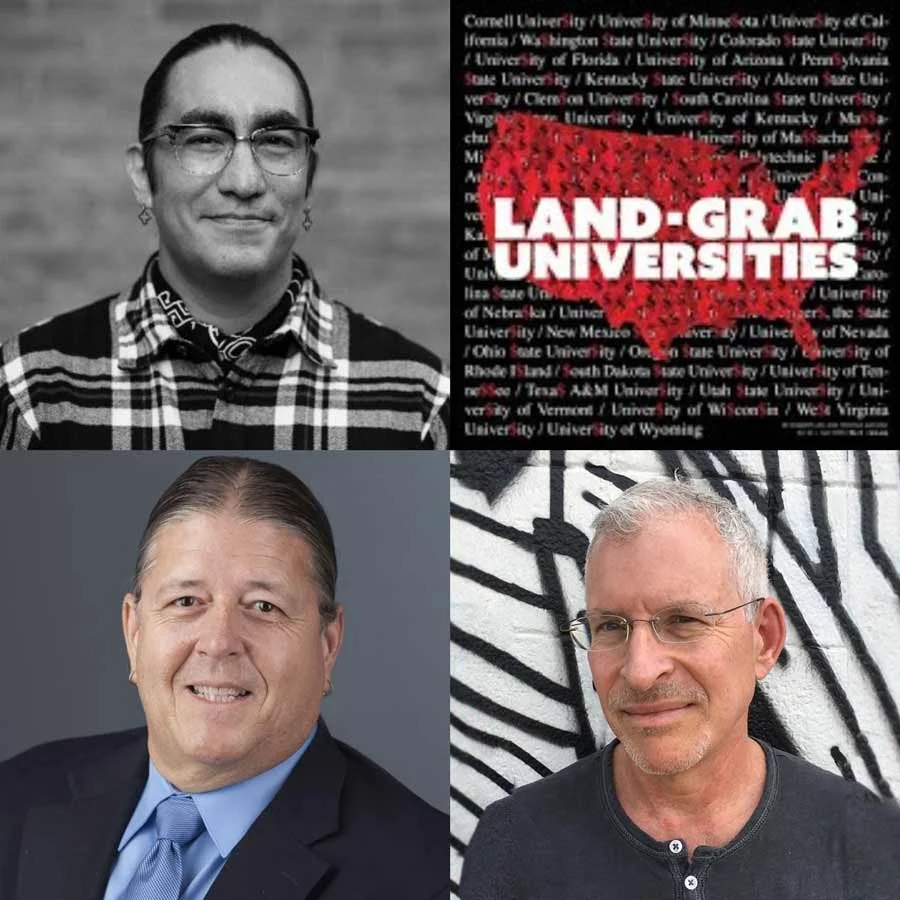
In this episode of the Speaking Out of Place podcast, Professor David Palumbo-Liu and guests Tristan Ahtone, Andrew Herscher and Robert Warrior take a deep look into universities, and education more broadly with We focus on a critique of land grant universities, which were built on land granted by the federal government. What we learn is that lands were stolen from Indigenous peoples through violence-based treaties and seizures. These 57 universities have used wealth derived from those initial acts of theft to buy more property, expand holdings, and enrich themselves. In contrast, we see the continued harm these universities do to Native peoples. This harm comes what Herscher calls “non-memory,” which creates knowledge that distorts and omits historical truths and impedes upon Indigenous futures. We talk about the deep damage non-memory does to education for all, and the ways people have fought back to retrieve, restore, and grow knowledge through scholar-journalist activism like the Land Grab University project.
DAVID PALUMBO-LIU
Maybe we could begin by having you all introduce yourselves briefly, and then I'd like just to go into the general project about land-grab universities and the broad overview, and then we'll gradually get into more precise kinds of questions and focus on Andrew's book. But maybe Robert, since you're at the top of my screen, we can start with you.
ROBERT WARRIOR
Hi, I'm Robert Warrior. I am a professor at the University of Kansas, where I teach in the Department of American Studies and in the Department of English. I write about indigenous studies, especially interested in indigenous politics and the way that these two things interact. Increasingly, I've been really interested in the way that I don't think that in native studies we've been interested enough in and have reckoned with our placement within institutions. And so I think that this is a really great topic for me to be in conversation with such smart people about and to really try to grapple with some of, I think, the underlying questions that are present within just trying to understand the universities and higher education, especially within the indigenous world.
ANDREW HERSCHER
I'm Andrew Herscher. I am a professor at the University of Michigan. I teach in architecture and Native American and indigenous studies and the history of art. Broadly speaking, my work tries to bring the study of architecture and cities to bear on struggles for rights, for justice, for democracy. I've worked across a range of sites. Because I live in Michigan on Anishinaabe homelands, I'm very interested, particularly in indigenous and colonial history around the Great Lakes.
TRISTAN AHTONE
Yeah, I'm Tristan Ahtone. I'm Kiowa. I am editor at large at Grist, and my work is focused on managing our indigenous affairs desk, so I work in the intersection of climate journalism, climate change and indigenous affairs. Most of my work has been focused on different aspects of indigenous affairs over the years, depending on the outlet that I've been working on. And so it was also one of the authors of the Land-Grab Universities investigation from a few years ago, which I had to actually reread today. I've mostly forgotten a lot of it, actually. I'm a little rusty on my own work.
DAVID PALUMBO-LIU
I'm glad you reviewed it because I'm going to ask you the question, right? Usually we think about, yes, so many of our institutions in the United States were founded on native land, and you think about that as that particular issue. But what your research and your activism has shown in the Land-Grab Universities is it proliferates. It proliferates out across different kinds of tableau and largely the idea of acquisitions become assets, and they grow the university's wealth. And as that happens, all of a sudden, the university becomes the point of attention, and the initial acts of violence are long lost or maybe acknowledged in a very perfunctory way. Tristan, talk us through this, especially things like the Morrill Act, which are so fundamental to this whole historical phenomenon that's unfolding as we speak.
TRISTAN AHTONE
Yeah. I guess I should start by saying is that when I originally got into this project with my co-author, Dr. Robert Lee, I think I was like a lot of other people in the US who thought that a land-grant university meant that it was built on land that was granted by the federal government. I actually didn't know what that phrase meant or what land-grant actually meant at all. I just thought that the federal government gave Texas A&M some land, and they built the campus, and that's why they're called a land-grant. During the course of the investigation, obviously, I learned that was completely different in that a land-grant university actually meant that the federal government gave universities through the Morrill Act land that they could basically sell and then use that money for their endowments. Now, most scholars had not actually stopped to ask where that land had come from in the first place. There was not a general broad understanding of where that land came from, that universities were given by the federal government to sell. So through our investigation, we wanted to ask, like, where did they get the land? How much did they sell it for? Who was impacted?
This kind of classic structure for an investigative story. Like, this law did this, who benefited and who was impacted. And sure enough, through our reporting, we were able to locate almost all of the lands that was donated to these 52 universities. It's about 11 million acres. And tying it to land session data, we were able to see that it came from about 250 different tribes and then cycled through the system into university endowments, basically starting those universities. Those universities couldn't have existed more or less without this massive influx of money from land that had been dispossessed from indigenous peoples.
I think also, again, when we talk about universities or the United States in general being built on indigenous land, this can feel hyperbolic sometimes, but I think one of the things that we're really proud of being able to do is actually locate each piece of land, who it came from, where it went and how much money it was spent. Like, we were able to show what the receipts looked like in this massive wealth transfer. We're talking about about half a billion dollars.
DAVID PALUMBO-LIU
That doesn't seem like much nowadays—for a university, but it's a lot when you're getting off of the ground, that that's what you need.
TRISTAN AHTONE
So that was just the broad scope of what we were looking at, is the Morrill Act, who was impacted, how did it start and what the impacts on universities in using expropriated indigenous land to get off the ground.
DAVID PALUMBO-LIU
Yeah. Just a small point, when did this project begin, or when did it start gathering steam?
TRISTAN AHTONE
This started in 2017. So this is when I met Dr. Lee. We were both doing a fellowship at the time, and I managed to sit in on a presentation that he was working on, where he had already been able to gather a lot of this information through digital records that had been compiled. So he was able to essentially scrape those land files for a lot of the Morrill Act acres that we're talking about through a lot of universities. But during the presentation, not only was I blown away by the work that he was doing, part of the presentation was that the rest of the work needed to essentially be done by hand. So his presentation was not only, “This is how far I've got,” in terms of the research here, but also what he has called a cry for help in terms of being able to do the rest of it.
And again, being able to step in and say, “Have you thought about working with a journalist before?” Because Dr. Lee is a historian. So for both of us, this was a big step in terms of having this hybrid, journalistic, historical sort of investigation and working together. Even when it came out, journalists were like, “This isn't journalism.” And historians were like, “This isn't history.”
Yeah. Nobody wanted to even claim us afterwards because that just doesn't happen very often, that sort of academic collaboration. But started in 2017, and really took about two years to really gather the information and then start reporting it out.
DAVID PALUMBO-LIU
No. So Robert and Andrew, your thoughts?
ROBERT WARRIOR
I'll just jump in and say I thought the project was just so compelling and important from the first moment it came out. The Land-Grab Universities project and that website is still around, and people should go on there and see it. I think it's one of those things that is so remarkable for being comprehensive, and maybe you couldn't track down every single parcel, Tristan, but the incredible numbers of receipts that you were able to gain is just so amazing, and I think it really gives the lie to anybody who says there's something wrong with it, right? It's not hysterical. It's not anything like that. It's really just information, right? It's just a big data project, and putting it in front of people in comprehensible ways is so important.
I'll just share one story. I had no idea how much Osage land had been given away by this US government, right, and land that the US government had gotten in sessions with, of treaties with the Osages. I already knew there were tons and tons of research universities and colleges and universities in our traditional homelands all the way from Boulder, Colorado to, you know, St. Louis, and to be able to think about those many universities now in the context of the lands that we had ceded in treaties being used by the federal government for its own purposes to create these institutions.
READ MORE [ + ]
The one story I'll share on this, I have an Osage relative who graduated from MIT a couple of years ago, and I just happened then to look at MIT on your website to say, “Where did MIT get its land?” And most of the land that MIT got, it's a land-grant institution, which I hadn't really thought about, but it's one of Massachusetts' land-grant universities, and a lot of it came from the Osages. And I was saying this then to the parents of Benjamin, this young relative of mine, who's an incredibly talented scientist who they paid for his way through MIT, and I said, “I think you should go to MIT and create a ruckus about this.” And they didn't do it, but it's certainly worth thinking about how institutions like that that play such an important role in the indigenous world and in the world in general, how does it make us rethink them to know that they relied so much in their early days on that? And sure, a half billion dollars only buys you half of the White House ballroom these days, but it was real money back then. I think that it's going to continue to have this impact, and I think as well with Andrew's book as I think one of the landmarks here in the early days since your project started of just what's a really great, thoughtful way of thinking about what this does mean. How does this challenge us to rethink institution by institution, what this data, what this information leads us to think about these institutions. Yeah.
Yeah. Land-Grab Universities made the enmeshment of indigenous homelands in the American system of higher education inescapable and urgent, I think, to consider. One of the things that really stuck with me about the project is the way it pointed out how land-grant universities were not only built on indigenous land, but with indigenous land, and how the basis of those universities was displacement and dispossession. The project, for me, also raised the question of how were universities that were founded before the Morrill Acts engaged with settler colonialism, and the university that I teach at, the University of Michigan, is one of those universities. It was founded in the early 19th century. And I think Land-Grab Universities came out in the spring of 2020, if I remember correctly. So it was just around the time I was starting to think about the University of Michigan's history. This was thinking that yielded Under the Campus, The Land. And so the project was absolutely essential for me and for the thinking that led to that book.
Could we talk more about the specifics of grants and treaties? Because these seem to be things that are hidden or else only partially disclosed or else incredibly distorted. So I'd love to hear all three of you talk about treaties and grants and what the actual mechanisms are.
Yeah, I might suggest, Andrew, you start with just talking about the Northwest Ordinance, which I think is something people know about. If you're a college-educated person about US history, then you probably have heard about it. But then seeing the way that you use that so effectively at the beginning of your book, I think is so telling about deletion, right?And how we just have to ignore certain things in history.
Sure. At the center of the campus of the University of Michigan, there's a very imposing neoclassical building, actually modeled on the Lincoln Memorial in Washington, D.C., called Angell Hall. And on the pediment of this imposing building is inscribed the first sentence of Article 3 of the Northwest Ordinance. It's a very famous sentence about schools and the means of education shall forever be encouraged. And in fact, if you go to the other side of the street, the main building of the College of Literature, Science and the Arts, on the second floor of that building is the room where the Board of Regents of the university would meet until about ten years ago. And the same sentence, the first sentence of Article 3, was on the wall in front of the table where the regents would meet and do the business of the university. Now, what's telling is that Article 3 of the Northwest Ordinance had two sentences, not one sentence. The first sentence was about encouraging schools and the means of education forever, and that's the sentence that's posted on the pediments of buildings and put into the rooms where the regents would meet. But the sentence that follows it is deleted, and that sentence is about observing towards the Indians utmost good faith in our dealings with them. So for me, the juxtaposition of this fetishization of the first sentence of Article 3 and the deletion of the second sentence of the article speaks volumes about the university's relationship to indigenous people and indigenous land. That is to say, the article documents very vividly how American higher education and indigenous homelands are enmeshed with one another. In other words, the authors of the Northwest Ordinance were not changing the subject when they spoke about schools and the means of education in the first sentence of the article and then moved to questions around dealing with indigenous people in the second sentence of the article. But what's going on in that article is a documentation of the enmeshment of indigeneity and higher education. And the deletion of the second sentence, along with the celebration of the first sentence, speaks to the way in which the contradiction has been negotiated, or actually not negotiated.
Tristan, Robert, you want to add on to this?
Yeah. I'll just jump in on that to say that was so interesting for me to read, and it really helped me crystallize some things about the relationship between land grants and the earlier institutions. I think there's a way, just starting with Land-Grab Universities, that you can think, “Okay, so maybe this is the truth, but we at least were innocent,” right? It's American innocence at work, right? The innocence abroad, the innocence at home now. But when you see that entire history that's laid out of these earlier universities, their charters and everything else, you know this has been going on for a long time. I taught at Harvard Divinity School in the fall of 2024 and 2025, and in 2024, native students asked me to come and speak at their Indigenous Peoples' Day gathering at Harvard Yard, which is within sight of where the Indian College was in the 17th century, and which was a chartered part of Harvard's mission, was to educate native young people. And as I walked over there, I thought, “What do I want to say to people today about commemorating these students?”Remembering the lives of those actual students who lived in the Indian College, and these just awful conditions, being fed worse food than anybody else, and working with John Eliot to translate the Bible for him, and then learning how to set the print for it, doing all the work and setting up a future in which a Tristan Ahtone would exist as a journalist as part of that whole history of print, right? I think it's a great sort of set of connections. But the one part of it that is really striking to me that I decided to highlight in what I said that day was that the Indian College is a reminder of this institution and other institutions' failure to really grapple with what does it mean to be about the business of educating indigenous peoples. I said, “This institution, Harvard, gave up on indigenous students 300 years ago. All those centuries ago, they just gave up on us and they decided about 50 years ago to take that up again.” But there's a long history of the failure that is really a part of that has to be taken into account. And I think that oftentimes that we allow ourselves to think in terms of why did those institutions like William & Mary, Dartmouth, Harvard and Michigan, why did they do this? We did it out of a recognition of actual things that were happening right in their midst. Of the agency, as Andrew, as you point out, I think effectively across your whole book, it's the indigenous agency that's at work in creating the reasons why institutions thought we can play a part in brokering a new relationship with indigenous people, right? Or feeling that of a necessity. I ended up thinking about this history of failure. We like to bemoan, faculty members at institutions these days like to bemoan that we've become these neoliberal institutions. Right? Embrace neoliberalism. The story about Michigan sounds exactly like a neoliberal institution, right? Deleting part of its history to say, “We've always cared about everything, and we're going to delete the parts that are now inconvenient for us to talk about anymore, because we can't really deal with it.” They're saying, “We need to understand as realists, educational realists, that we can't deal with some things, and we're going to forget our history and where we came from, and the people who we actually worked with to create these institutions.”
Yeah. No, that's such a great point, and then you add onto that the whole Trumpite acceleration amplification of this across everything. Tristan, do you want to offer us some thoughts on this?
Yeah, I think in terms of even the Land-Grab Universities project, looking at that history and really beginning to learn more about the history of education in the United States, and especially Indian education, a lot of that was new to me, still is new to me because it's not my area of expertise. And hearing what Robert and Andrew are talking about, I think are really vital ways to understand what relations with indigenous people could have looked like in the United States were those ideas actually honored in the first place by these institutions, by the people who supported these institutions. To think of that alternative reality that may be happening someplace in which we are kin and we are in respect with each other is a really interesting world to think about. And I think there's still a world in which there's a possibility to think about a future that looks that way. But I think for me, in imagining that future, I think it's still coming to terms with not only the past of deleting the stuff that doesn't work for us anymore. So our project that we did about two years ago, building on Land-Grab Universities, was our Misplaced Trustinvestigation at Grist, in which we wanted to go back to those universities and start looking at not just the history of how they got their finances, but then looking at now to understand how dispossession is ongoing and extraction is ongoing. So we're looking at those treaties still, and we're looking at those land grants in a different set of grants that are providing land and income to these same institutions and as well as broadening that out. One of the things that worried us a little bit with the original land grab story was that at least a lot of non-native scholars were able to say this was something that happened in the past and it's unfortunate, which is something we hear a lot in Indian country about any of our history. So building on that and continuing to build out that research on the past and even what's going on now in terms of these institutions and how they continue to profit off of dispossession, I think is really important for us to continue to think about and produce information and open source data for people to use and think about that this is just one part of a very large systemic issue of land grants, broken treaties, dispossession, expropriation and looking at how indigenous lands continue to enrich settler institutions. Because I think one of the big things we were looking at, even with our latest research and investigations, was that I think in the past, and even still now, there's always been this sort of racist idea that Indians as wards of the state that just live off the state, or, you know—
Living off welfare. It's, we get free college, pay no taxes, all of it untrue. These kind of racial stereotypes stick, and then when we actually look at the data, we can say actually the K-12 schools can't exist without indigenous resources and without extraction on indigenous land. So really what's happening here is that that stereotype about indigenous people is untrue, but it is true about settlers. It is true that their systems can't survive without indigenous resources. So I think being able to start thinking about those in the ways in which these systems are operating is really important for us in terms of thinking about what futures can look like.
Yeah. I'd like to take some of what you just said and combine it with another question I was going to pose to you all, and one was the word education has been circulating a lot in our conversation. So let's talk more about education and the purpose of education and the specific purpose to which education was going to be put by native peoples. In other words, why would they want to be educated? What were the practical as well as intellectual issues that were foremost? And then let's dig down and expand what kinds of wealth have been generated by this proliferating, as I said at the beginning of this podcast, this is the instigation of something important in terms of capital and expansion acquisition that carries with it also all sorts of ideological and value systems that are constantly displacing indigenous notions of what counts. So let's start with the education piece.What did they want with education? What was it for?
I can talk about the University of Michigan because it was arguably founded by Anishinaabe people in the early 19th century living around Detroit who were interested in building an educational institution where their children and settler children would be educated together in the context of a vision they had about sharing their homelands with American settlers.
So the treaty that arguably brought the University of Michigan into existence, the Treaty of Fort Meigs, which was signed in 1817, had a number of things going on in it. But the thing that's pertinent to this conversation is that in the treaty, a group of Anishinaabe leaders granted three sections of land to what was called in the treaty, the College of Detroit, believing that they may wish some of their children hereafter to be educated. That's the words of the treaty. And at the time, there was no college in Detroit. And four days after that treaty was signed, the first College of Michigania was founded in Detroit. And that four days is pertinent to me because it would have taken three days for a settler to ride his horse from Fort Meigs to Detroit. So it's very clear that the first College of Michigania was founded specifically to receive this land that the Anishinaabe had granted in the Treaty of Fort Meigs to found an institution where their children and settler children would be educated together.
And I think the historical evidence points to their understanding of education as useful for them as a way to better negotiate with settlers, with settler colonialism on their terms. And in this time, this is 1817, the white population of what was then the Michigan Territory was around 1,000 people. It was confined to Detroit. The rest of the Michigan Territory was under native sovereignty. And I think the Anishinaabe had a vision of a world in which they would be continuing to live together, collaborating with, co-educating with white settlers. Of course, white settlers had a vision of a very different world. But there has been, since the treaty was betrayed, and that betrayal started in 1817 when that land grant was made, that betrayal has been contested repeatedly, continuously by Anishinaabe people in Michigan up to the present day. Let me say one more thing.
I think from the standpoint of settlers in the 19th century, and maybe this is also true to some degree today, the settler perspective is that the indigenous people wanted education to assimilate, to become like them. And what the historical evidence points to me, especially in the 19th century, is that indigenous people wanted education not to assimilate, not to become like settlers, but to better negotiate with settlers on indigenous terms.
I think the reason why this land grant was made in the beginning of the 19th century was that there was already experiences with all sorts of fraud, swindling, the uses of the legal system as a weapon, and indigenous people wanted to learn about the settler world so that they could negotiate with that world on their terms, not on settler terms.
All of this makes me think that we really need to think through the idea of the university in a new way, right? Oftentimes, what people are trying to do in general is to revive a discourse about universities, what they are, what they can be, what higher education can be, without going back far enough to really rethink all of the things we need to do. Andrew's point is a really important one.
So often what people have aspired to is to, I think indigenous people in helping to create universities and working with them and cooperating with them, has been to try to recreate the best ways of relating to people that came out of those early colonial times, the earliest times when people were having to share, when people were trying to figure out, “How do we live together?” Not in this really grand, romanticized way. We just want to be together in the world, right?
Just saying, “You're here, we're here. How are we going to do this? How is it going to work?” And then people found some ways that worked. It usually meant people learning each other's languages, figuring each other out over time, respecting boundaries and all these sorts of things. And let's send some of our people over to you. They can learn some of your things. Send them over here. We'll teach them our things, right?
And without romanticizing those things, saying, “What can we do to really figure out what that vision would be,” right?And instead of either of us bringing tons and tons of assumptions to it, can we create situations where I think those of us who are people who teach in universities, the things that I'm always attracted to, I like a lot of things about these educational institutions, right?
The great students we get, the unexpected moments when people are open to new ideas, right? And the things that keep us teaching, the things that keep us thinking about why these things are worthwhile and why we want to do these things. But at the same time, I think that it just really requires some really tough mindedness in saying that doesn't mean we should just buy into whatever somebody's just saying,“Hey, we need to get together and figure out how to revive the university and the idea of the university.”
And I say, “Look, I want to have that be something that is contested in really sincere ways.” I think that some of these ways of thinking about what indigeneity does in the discourse of higher education are things that strike to the roots of the universities themselves and require some real careful thinking. Not to say we don't have to figure this out before we move forward, but as we move forward, I hope that we can really grapple with it. I think of a student, Kevin Connolly, who I think was Oneida. He was a Six Nations student at Cornell when I taught there for a year back in 1999, 2000. And Cornell is, of course, as everybody here knows, but some people may not who are listening, a land-grant university, and the American Indian program there is part of the land-grant part.It's at SUNY Cornell and gets part of their funding from the state of New York, so it's public, and then the rest of the university is private.
But Kevin would say, “How come with my language program that I work with in reviving our language, I want to take it out to the communities and people will say, ‘We can't do that’?” But we're constantly extending ourselves as a university into communities. We're a land-grant institution. We have an extension office. Now these land-grant universities like Illinois, where I was, had things about doing consumer extension, like consumer engineering. That was part of the land-grant part of the university, right? Saying that's part of our mission is to say Chicago is part of what we extend to. And yet poor Kevin was just sitting there saying, “I just want to bring to citizens of the state of New York, people who live in New York, who are part of this state, the learning that I think is important for them to be able to access through the university's programs, and people are putting up barriers to this.” Why, and how does that work? How do we overcome those barriers in doing something else? And I think that those are the kinds of things that help us to get away from land acknowledgements that are performative, which everybody agrees are things we don't want to do anymore. But everybody's just going, “Ooh, we don't have to do that anymore.”
Yeah. Well, sure, but let's do something else. Let's do something that's tougher-minded. Let's do something that's more rigorous. Let's do something scholarly, how about? Let's do something that we do in that old medieval sense of a university, of people from different perspectives sitting down together and really considering each other's points of view and challenging each other in ways that are meaningful.
Yeah, I love what Robert is saying about universities as spaces to negotiate difference, because I think that was really, from the historical evidence that I'm working with, at the heart of the Anishinaabe vision of the College of Detroit that they were founding in the Treaty of Fort Meigs, and that was betrayed by the administrators of what became the University of Michigan. And that vision of a space to negotiate across differences is still very much contested at a place like the University of Michigan. We see this constantly across a range of different issues, including, but not exclusive to questions around indigeneity.
Yeah. No, I very much share your notions about what is exciting about the university and frustrating at the same time.And the frustrating part is how they talk a good game about civility and great discussions with people who don't agree with you, but then delimit it in so many soft and hard ways. Here we are in Silicon Valley and big boom in AI, and now an ancillary critical AI faction moving up. And there was a really interesting presentation by a student named Mesli Caraval, and she was talking about AI and the discourse of the frontier.
And she talked about how did this word become so enshrined and what are the assumptions that come with it, which I thought was very important. And one of the things that she said that was particularly striking to me is she said, “It carries with it a sense of inevitability.” This frontier will be crossed in this way and it has to be, et cetera. So these are important boundaries we have to transcend rather than question.
So let's talk a little bit about the financial piece. This has been a great discussion, but I would like to really give our audience a sense of the dimensions of the profit and the spiraling advantages that institutions like Stanford and others have in retaining this particular configuration of where native peoples belong or don't belong, what the proportion of knowledge or acknowledgement would be, symbolic or non-symbolic, and then why are they doing it?
It's part ideological for sure, but also part just because it's profitable. It keeps a certain kind of machinery going. So can we talk a little bit about those figures? Because they really popped out at me, and I'd like to have you all share them with our audience.
You mean in terms of the initial profit from—
Yeah, and once it was set in motion then.
Yeah. The numbers are like, it's really extreme sort of disparity between compensation when there was any compensation for land and then university profit. Like I said, half a billion dollars when adjusted for inflation, total that these 52 universities made. And we figured out that the United States paid less than 400,000 dollars for extinguishing indigenous title.
And even to this date, it's not really a great measurement because where payments were made for a land cession, the language of colony here is money. So this is the language that we're using, right? We're of capital to draw comparisons, but when we say the United States paid less than 400,000 dollars, we still have to think about, like, all the times that the United States didn't pay anything at all.
So it's still this idea of you have ten people in a bar, average income 80,000 dollars a year. Bill Gates walks into the bar and suddenly the average income is 6 million a year. You know what I mean? One person can throw that math off entirely by extreme wealth here. So when you think about California, there's no compensation for tribes to be dispossessed of land.
Arizona, for instance, almost entirely Arizona is... This is gained through warfare, essentially. Sometimes there are payments being made to tribes coercively, sometimes things are being gained through warfare. And again, the money, I think it was University of Nebraska had a graduating class of something like, what, a dozen people or something like that in their first. Most of these universities, when they get off the ground, they have 20 people who graduate. Their incoming class is 20 or 30 people, even less sometimes. So, you know, it's not like they're throwing the doors open and having hundreds of people walk through there. These are from-scratch institution situations.
And I think it probably gets back to even what Andrew and Robert are talking about, sort of the point of the institution, where you go with it. I really appreciate hearing not only where there are terrain for debate, as well as looking at that history, because I think the 1862 Morrill Act was really aimed at fueling economic development. It was there to broaden access to agricultural and mechanical education for working-class citizens. So these were ultimately, for settlers, these institutions functioned as a system that was constructed to extend settler colonialism into the future, right? They're learning how to continue to move west.
They're learning how to turn the landscape into money. These are all the things that are happening here in terms of eye-popping numbers to get off the ground, and then getting a system that's going to continue moving forward. And I appreciate hearing Andrew talking about how the difference is in how Indigenous people are thinking about education at the time, that it's a place to learn to negotiate.
It's a place to ask these questions. So those figures, those numbers and putting this sort of system in place, in motion does speak to, I think, also what Robert's talking about, too, in terms of what the purpose of education is. And what I think about is that I think historically, education in the United States, at least settler education, has been about reproducing systems, colonial control, assimilation processes for Indigenous peoples.
I think what we're seeing more and more in terms of what a university can do now, at least from an Indigenous perspective, is definitely something that's more decolonial resurgence, building sovereignty, building community-minded people, turning people back into their communities to build on ideas of sovereignty and self-determination, capacity building. Really, these are different ways of thinking about what you do with an education and what you do with founding dollars and cents.
But also, Tristan, in that way, I think that also thinking about what do you do about the forms of education that already exist within a group of people, right? So that how do you take those Kiowa or Osage or Cherokee forms of education that are already in existence, which are fairly, pretty complex, and you know, they have their own integrity about them. We decided to start a dance for Osage women and girls several years ago, and I became the head cook for that, and I had to really learn along the way how is it that Osage girls learn how to be cooks? And they start at a very young age learning how to be cooks in ways that boys just aren't really around very often.
And so I had to learn a lot of those things. I had to learn about how to cook in other ways, and the two professional cooks that I have who are chefs who I work with on that, and the other men that I work with, most of us can get our way around a kitchen. But the other many things we needed to really know were things that we would have learned through a whole process that's organic to who we are as Osages, and it is built into our way of life, and had its antecedents 300, 400, 500, 1,000 years ago, right? In the way that we just raise our children. And so those forms of education, I remember writing about education in the late 1990s and running into Henrietta Whiteman's work and her saying she has a PhD in education. And she said, “We've had education forever. We used open-air classrooms. We used modular ways of learning.
We used scheduling in different times, in different ways.” And just seeing the elaborate nature of those ways of thinking about what education is. And in that, you have to confront the ways that we pay a price as indigenous people with the assumptions people make about our savage ways, right, that are deeply embedded within consciousness of people in the US.
You need to come to school because otherwise you're just going to be out there just running crazy and running wild. You have no form of education, right? And to say, “That's not exactly the case. It's not really the case at all.”
And I think you're speaking about too, in terms of thinking about futures of education, is I completely agree with you that it's not necessarily turning away from even Western forms of education, but it is a conversation about whether we're trying to decolonize Western systems that have been imposed on us and/or putting resources and time into developing systems that have already existed, right?/ It's decolonization as code word for DEI or decolonization—the idea of changing over how power structures and rethinking what we're doing with those. So I think, yeah, what those futures can look like, I am a pretty strong supporter in saying I want to put my energy and my time into thinking about how we support those systems that you're talking about, Robert, about those ideas of like, how have we done things in the past, how there are so many things that we've forgotten, but they're better than almost anything that the settler can remember, as far as I'm concerned.
Yeah. And that means that we can spend time developing those, thinking about them, thinking critically about what kind of world we want to build, or spending time trying to decolonize Cornell, which I don't think is ever going to happen.
Mm-hmm. You got me exactly to the last question I wanted to ask all of you, which is based on something that Andrew has in his book, which is the relation between non-memory and indigenous futures. And you do have a really powerful statement about how non-memory forecloses certain kinds of futures, but we see them emerging again despite these kinds of acts of purposeful erasure or distortion.
So could you all talk about the future? I think this is really important and its relation to non-memory. How do we emerge from that, I guess, is one way to say it, and how is it being done now?
I'll just say as somebody who is in higher education, that I think it's a matter of refusing non-memory at every turn, and not always highlighting it, but always keeping in mind that by refusing to forget, by always enlightening my own thought, that there are specific ways that I may not even know yet that my ancestors were actively participating in the processes I'm still a part of, and that our leaders would have been in the 19th century in these really intense moments of having to think about what removal would mean and these various sorts of things that they had to go through. That they did so smartly, more so than I can, in a wiser way, with an understanding of Osage philosophical concepts that I could never even approximate.
But the closer I can get to that, the more I can appreciate that, the better equipped I am as an Osage person—as a person, to bring myself and the things that I know into the arena of ideas, and to try to just do my best, to washkla, as the Osages say. You do your best, and that's what I'm always trying to do, what I'm always trying to be. But that requires refusal every single day to say, “I'm refusing something that other people don't even know exists,” right? Yeah. They don't know that non-memory, as Andrew puts it, even exists. Because I refuse to participate in that non-memory, it makes me better equipped to be a part of that future. And I think that there's so much discourse around these days, the crisis of higher education, that we're facing a future where we don't have the opportunities anymore to do the things that we'd assumed that we need to do, and that we need to be the university of the future. And I think that I'm just really happy that I've been thinking that way for a long time. I think that's what we bring to the university from an indigenous point of view, but I think that's available just by really good and solid thinking and careful work. And I just want to say really quick, this will probably be the last thing I say, David, but I think this is the...
It's always the time to make the international global connections within indigeneity that help us to see a broader world. I think just really quickly of Aileen Moreton-Robinson saying it's not just that she sees that there's a settler insecurity that actually prompts all this. It's not settler confidence that creates non-memory. It is that sense of insecurity, settler insecurity over its own title to the land that creates that, and I think that plays itself out. All of this has helped me to see in an even more powerful way that when my Palestinian colleagues will remind us about where various things are now situated, universities in Israel created on a village site of a place that was wiped out in the Nakba, right?
What does that mean about that institution, right? And it doesn't mean the institution doesn't exist or shouldn't exist. It does exist, but what should that mean to that, and how do we grapple with that and think about that? And that all of these things from around the world really should help us focus and help us to really be able to drill down into history, looking forward to a future that is different.
And I think that's what we should want and can want, but it takes some work.
That's such an important point. I would just plug Maya Wind's book, Towers of Ivory and Steel, which gives a deep dive into the educational, non-educational, non-memory system, the discourse system in Palestine. Andrew, you were going to say something.
Yeah. I think Robert made such an important point about the relationship between non-memory and settler anxiety and settler insecurity about the history of colonialism. This makes non-memory a very tricky phenomenon to negotiate because it's not simply forgetting or neglect or amnesia. It is a form of historical recall. It is an engagement with the past, but it's an engagement with the past that's structured by the logics and practices and ideologies of colonialism. So in the case of the University of Michigan, the university is very invested in self-historicization. I call that colonial non-memory because it is structured by all sorts of elisions and displacements, and in some cases, falsifications that sustain the ideology of colonialism on its terms. As a settler member of a settler institution, I see my role as contesting non-memory and to bring to that contestation the resources and skills that I have, and also to support whatever emerges as indigenous futurity. In the case of University of Michigan, this mostly takes place through native students and native faculty.
So Tristan, we began with you, I think, so it's fitting we end with you. What would you like to say about futurities and non-memory?
I agree with what everybody's saying here. I just finished up reading Charles Mills, so this is actually something I've been thinking about in terms of the epistemology of ignorance and you know, collective amnesia.
So this is something I've been thinking about. But when I'm thinking about how we choose to remember or what is remembered, what's going into sort of the official records here, again, I think the thing that I'm really trying to focus on right now is really what forgetting basically means in terms of thinking about the future, is that not only is that sort of that settler memory actively erasing ideas of indigenous futures, but I think also even for us as indigenous peoples or scholars or reporters or whatever, is that if all of our time is basically being spent in having to invest in counter-narratives or to correct the history, not only is the sort of ignorance erasing our future just by not being honest about its past, but it's directing all of our energy into having to correct that past. Yeah. So I think this does this double work here in terms of erasing what can be different futures for us. So this is something that I really have been thinking about quite a bit recently. But in terms of these projects and others that I work on, I think trying to educate the general public on the things they probably should've learned in school but they don't in terms of indigenous history is a big part of the work that I do.
But I also think a lot of it is, to Robert's point of making those international connections, is something that I think about a lot today, is that I now, I think, realize that it's not necessarily trying to explain our history necessarily for a non-indigenous audience, but it's explaining our history and the specifics for other indigenous audiences in other parts of the world that share colonial histories, but may not have the same specifics as we do.
Because those are the things that I want to hear from other parts of the world. I want to hear the specifics from Chad or New Zealand or anyplace else, is to hear those details because I don't have those details to understand their history, but I have a basis in understanding colonial history.
Mm-hmm. So therefore it makes it a different game to start making those international connections and thinking more globally, even if it is a pan-indigenous movement that we're thinking of. I still think this is something important to consider since it is still a very solid sort of like pan-European, pan-white wall that we're going up against here that we have to think about dealing with and doing our best to dismantle.
Yeah. It's really striking to me, picking up on what Tristan and Robert were saying about the connection to the more global questions, is how it was the Gaza Solidarity protest at the University of Michigan that brought students in a really concerted way to think about the university's own relationship to US settler colonialism. That is, the students are making those connections, and at Michigan, just like at other campuses, it was the administration of the university that was trying to foreclose students investigating and exploring those questions, and they did that ultimately by bringing in the police, which gets to the very high stakes of making these sorts of connections. Because they involve actual questions about the distribution of land and labor and capital.
Yeah. I mean, I'll just mention this, but the Michigan encampment and the reaction of the president there was vicious, but what was so ironic, and it gets back to non-memory, was I think the prior president had done this big ceremony about McCarthyism and how it was so important to remember how the government had oppressed the university, largely centering on Chandler Davis and those folks, right?
And then, of course, when Gaza happened, they doubled down on renewing contracts with Israel, and this will not interfere with the university, so it was a terrible non-memory. In terms of internationalism, I was thinking about also Leanne Simpson's theory of water, which ends on this notion of indigenous internationalism, which I think is an interesting idea.
But maybe this will be our next conversation. I would love to have you all back to continue this because these issues are real and they're important, and we benefited so much from your brilliance and your passion and your devotion to education globally in the best and most capacious way for the futures of the planet. So thank you so much for being on.
You're welcome. Thanks for having me.