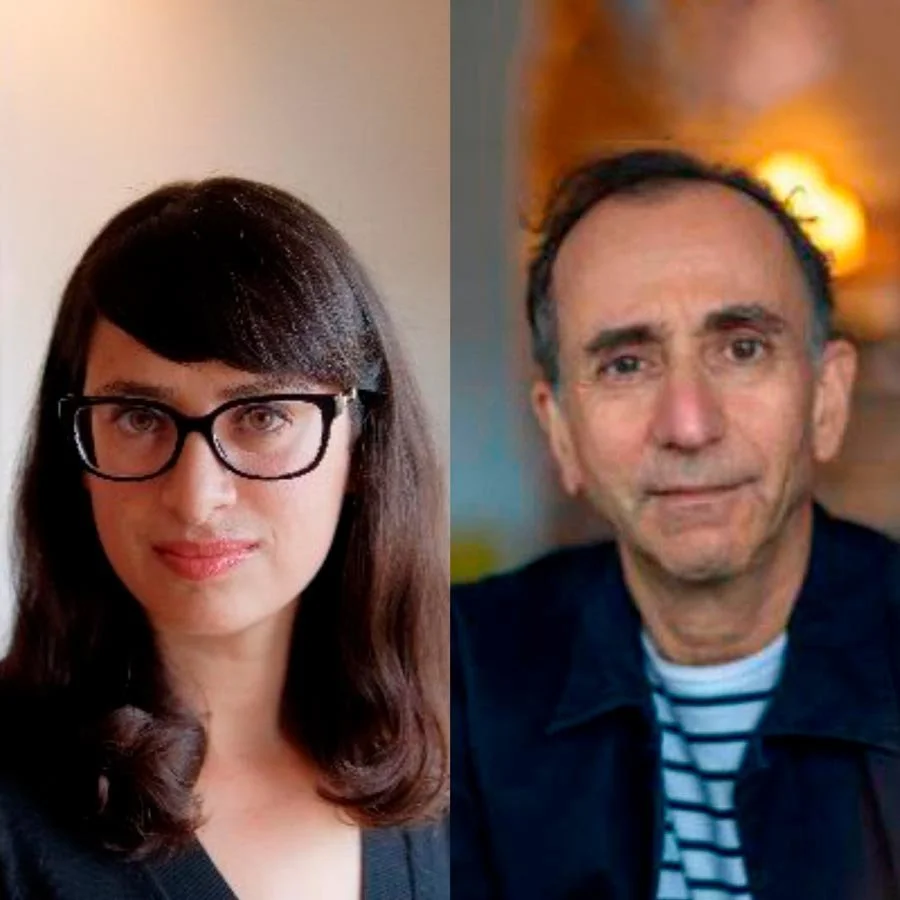


In this episode of the Speaking Out of Place podcast, Professor David Palumbo-Liu talks with Nicholas Mirzoeff and Priscilla Wathington about the genocide in Gaza, and how developing a new way of seeing and writing is demanded of us to address this historical moment. In the words of Silvia Federici, “Palestine is the World.” We take Nick’s recent book, To See in the Dark, and animate it by having Priscilla read from her poetry.
Nick writes: “After a year of genocide, I think politics is now the meeting of the visible and the unspeakable. Unspeakable in that what is visible is so awful as to be beyond ordinary words. Unspeakable in that what is visible is forbidden to be said. What has been sayable about the unspeakable? It has been poets who have found ways to make language do what it should not have to do.”
The goal behind this dynamic interplay is to create the grounds for solidarity with Palestine, and with all other oppressed peoples in the world, and with the planet itself.
Speaking Out of Place is produced in collaboration with The Creative Process and is made with support from Stanford University.
Nicholas Mirzoeff is Professor and chair in the Department of Media, Culture and Communication at New York University. To See In The Dark: Palestine and Visual Activism (2025) is being translated into Czech, Italian and Spanish. It is the most recent of more than a dozen books, including How To See The World (2015), translated into eleven languages. Since Occupy Wall Street (2011), his work has been in dialogue with social movements, including Black Lives Matter (The Appearance of Black Lives Matter) and #MeToo. His writing has appeared in the Guardian, The Nation and LARB. He lives in New York.
Priscilla Wathington is a Palestinian American poet/editor and the author of the chapbook, Paper and Stick, which draws from her past human rights advocacy work. She is asking you to resist the lie that you are too helpless, or too busy, or too small to change anything. Take your small hand and your small voice and add it to this symphony against the genocide taking place in Gaza; and speak up not only about Gaza but also Sudan, and the Democratic Republic of Congo, and your own backyard, and everywhere that humanity is at risk.