

What is enough childhood for a people to stay alive? What is enough childhood for a people to stay alive? What image of childhood is enough for a people to stay alive?
Speaking Out of Place is produced in collaboration with The Creative Process and is made with support from Stanford University.
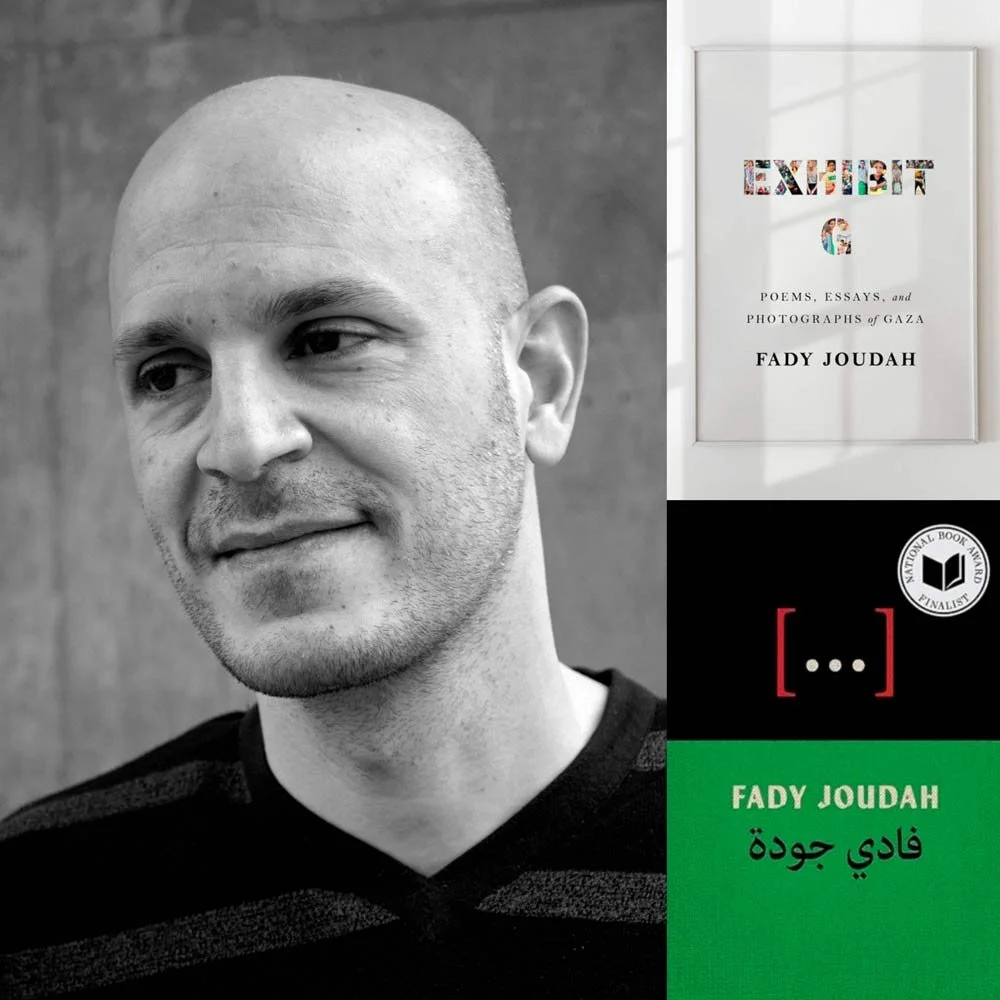
In this episode of the Speaking Out of Place podcast, Professor David Palumbo-Liu speaks with poet and physician Fady Joudah about his stunning new book– Exhibit G: Poems, Essays, and Photographs of Gaza. Along with powerful and demanding texts, Exhibit G features a collection of photographs of Gaza presented in collaboration with Hani Almadhoun and the Gaza Soup Kitchen. Together, we are confronted with a demand to witness without translating the experience into what Joudah calls “Palestine in English.” The totality of the experience is at once devastating, horrifying, but also at times beautiful and literally beyond words. Along with reading portions of the essays and poems, Fady Joudah offers his usual probing readings of Palestinian history, culture, literature, and social life. No other document so forcefully and comprehensively expresses this genocide.
Fady Joudah is a Palestinian American physician, poet, and translator. He was born in Austin, Texas, and grew up in Libya and Saudi Arabia. He was educated at the University of Georgia, the Medical College of Georgia, and the University of Texas Health Sciences in Houston. In 2002 and 2005 he worked with Doctors Without Borders in Zambia and Sudan, respectively.
Joudah’s debut collection of poetry, The Earth in the Attic (2008), won the 2007 Yale Series of Younger Poets competition, chosen by Louise Glück. Joudah followed his second book of poetry, Alight (2013) with Textu (2014), a collection of poems written on a cell phone wherein each piece is exactly 160 characters long. His fourth collection is Footnotes in the Order of Disappearance (2018). In 2014, Joudah was a Guggenheim Fellow in poetry. As critic Charles Bainbridge observed in a 2008 Guardian review of The Earth in the Attic, “Joudah’s poetry thrives on dramatic shifts in perspective, on continually challenging received notions.”
Joudah translated several collections of Palestinian poet Mahmoud Darwish’s work in The Butterfly’s Burden (2006), which won the Banipal prize from the UK and was a finalist for the PEN Award for Poetry in Translation; and in If I Were Another, which won a PEN USA award in 2010. His translation of Ghassan Zaqtan's Like a Straw Bird It Follows Me (2012) won the Griffin International Poetry Prize in 2013. His other translations include Amjad Nasser's Petra: The Concealed Rose and A Map of Signs and Scents. Joudah lives with his family in Houston, where he works as a physician of internal medicine.
DAVID PALUMBO-LIU
So Fady, welcome. It's wonderful to have you back on the show, and especially to talk about this absolutely stunning and utterly devastating book. There's a lot to talk about, but perhaps we can start by you telling us how this project came about in terms of the particular combination of elements, its conception. It's a very unique project.
FADY JOUDAH
Thank you for seeing it that way. I think there are two easy ways to think of this. One is an extension of the previous book, [...], because I felt in that book it was a writing that preceded the genocide in the sense of the language itself, and it was more immediate for that articulation to happen as the genocide began, because as a Palestinian, you had a conscious understanding of the process of your erasure, especially in English. And I wasn't satisfied with that, and there was so much more language to be engaged and embrace or tussle with. And so I began to write these longer pieces. But primarily in the longer pieces, I began to notice that at the height of the genocide, with the mass killing on a daily basis, that all these videos were circulating. And I felt there were these elements of Palestinian-ness in Gaza that are not captured by most people who are just circulating and talking.
FADY JOUDAH
We were further abstracted, despite it being an intensely visual genocide, the first live-streamed genocide and all that, the Palestinians were still abstracted despite the imagery.
And so I began to just use a sample of videos that really moved me deeply to—and also my private experiences, since I have family in Gaza, to begin to move the text and open it up and have these sprawling pieces. And that's talking about the text a little bit. From the standpoint of the photographs, what happened was Palestinians, we were flocking together. And one of the people I ran into early on in our efforts during the genocide was Hani Al Madhoun, who's a philanthropy director of UNRWA, but also he established the Gaza Soup Kitchen, and he had his family, siblings on the ground. One of his brothers and the family were killed by an Israeli strike. They could not retrieve the body, et cetera.
His way of dealing with it was to create funding that would provide food and water for people, especially in northern Gaza initially, and other pockets. And I joined the effort in support, and whatnot. And what happened initially was photographs. So they hired photographers to send us photos so that we can do the fundraising, no doubt. But then I found myself completely alive and in ways I can't even describe.
Because I realized that these photos were taken by Palestinians of Palestinians.
In a particular manner that neither denied the hardship, the horror, the rubble, but did not focus on blood and gore. And then I began to see what was happening and because the photos were by the hundreds every day, and I began to see that because of when the Gaza Soup Kitchen started, it was a small location, so there are some of the same people coming. So it's like me watching, being alive with those people. Second, it was the way they were dressed, especially the children. I began to see patterns of life as if somehow this is documentation of their life in the middle of a genocide and before it.
And I really felt so alive and an honor to be Palestinian, to see those Palestinians through Palestinian eyes, and to see the vibrancy of color, the insistence on it. And a pattern began to form in my head about curating the photographs. And one thing I realized and accepted early on is that I was not trying to curate the photographs to fit the text, nor was I going to write a text that fits the photograph, except for one main text, Exhibit G, Surviving Image early in. Because it just—not to ignore that aspect of this unique project, as you say.
DAVID PALUMBO-LIU
Yeah. Would you mind reading a bit from that poem because it frames it wonderfully, especially the way you just introduced the topic.
FADY JOUDAH
Yeah. It's a long piece, but I'll read from it. Exhibit G, Surviving Image. Israel killed his younger brother, sister-in-law, and three of their four children. The daughter who survived, Salam. Their corpses could not be retrieved, rubble and snipers. In lieu of grief, my friend decided to start a soup kitchen during the annihilation. "Family and friends will run it," he said. "My youngest brother and my sister." Israel would later assassinate his younger brother. He would be buried. Salam would go on to have a baby girl. The photographs from the kitchen start coming in on app threads.
The beach is nearby. The children can't get to it. To take away the sea from children is a war crime. Every tenth generation spans all generations. Children out in the elements in line for food and water. Their hair all sorts of colors. DNA, the sun, malnutrition. The adults who send the children to collect sustenance and the adults who serve them refuse to let the children lose what remains of their childhood in G time. They remind the kids to smile, what they'll bequeath to their Palestinian lives, a smile between the face before and the face after. The world that produces horror circulates its horror in images. Self-rebuke as a form of self-congratulation, war crime as humblebrag, while bloodlust is inevitable. To play transparent so that the players may forgive themselves.
What is enough childhood for a people to stay alive? What is enough childhood for a people to stay alive? What image of childhood is enough for a people to stay alive? A child's smile triumphs over terror as Icarus triumphed over gravity. Sometimes the children smile on their own. Often the adults prompt them. The kids are primed to fall for it. They smile as if they'd never known anything but happiness. To state they were here once, on Earth, in happiness, so that we may say we were here once, Palestinians smiling. And here the promise of food resembles joy, a bribe for a doughy mind, water everywhere, and not enough for a child to cry. A dry run for deep sorrow. A bribe may run out before you get your share. A mother knew this fifteen hundred years ago. On a moonless night, she boiled stones for her starving kids to calm their hunger pains. The soup tasted earthy, full of minerals. Their hair did not change color...