

The words on the page give us a sense of loss. The blank space also gives us the sense of the loss that we don't know and can never know. The sense that there has been an absolute destruction. Absence has been imposed on places where there were lives and a culture that was vibrant and rich. That sense that this is a genocide for which there is much evidence and that we have watched unfold in real time and that we have seen, we have had it, the evidence crowding in upon us at every moment.
Speaking Out of Place is produced in collaboration with The Creative Process and is made with support from Stanford University.
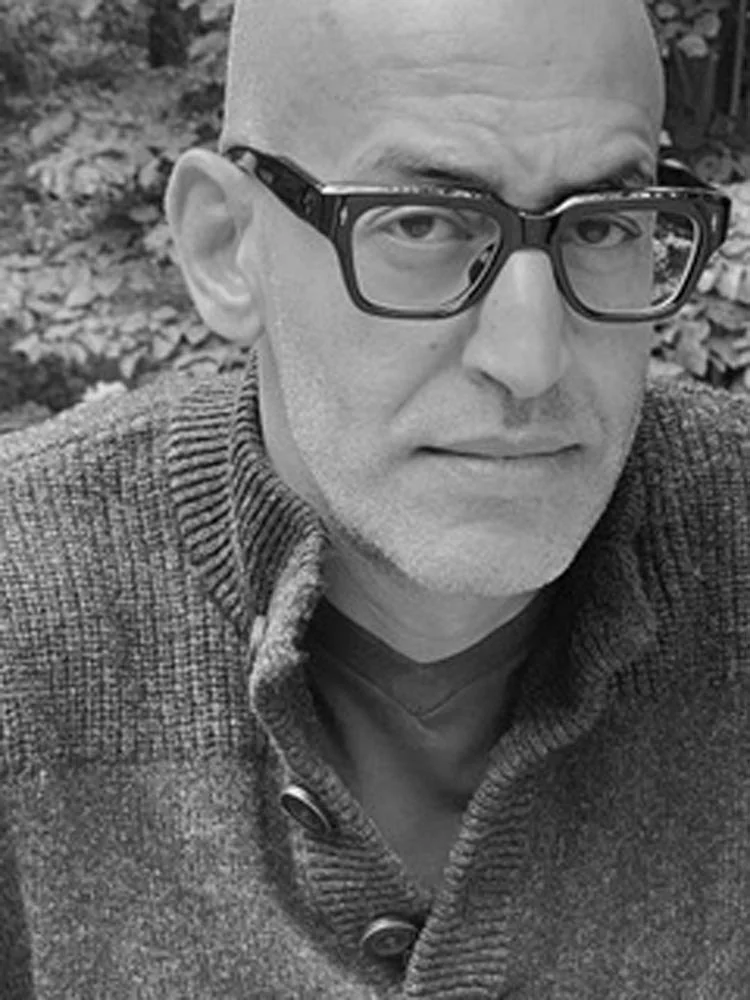
In this episode of the Speaking Out of Place podcast, Professor David Palumbo-Liu talks with Feisal G. Mohamed to discuss his new poem, Nowhere is safe in Gaza. This book is “an erasure poem using as source text South Africa’s Application Instituting Proceedings against Israel for Violations of the Genocide Convention,” presented to the International Court of Justice in December 2023. We talk about both the distance and also the bridge between the legal filing and this poetic creation, which re-distributes the language of the filing in different spatial manners, both allowing, and forcing the reader to confront the genocide from multiple viewpoints and with different emphases.
We speak of the programmatic and historically deep instantiations of Israel’s genocide, and bring forth the voices Israel has attempted to silence forever. In particular, we recall the words left behind by martyred physician Mahmoud Abu Nujaila, “We did what we could. When the guns fall silent and the true scale of devastation is revealed will the [UN] Council and its members be able to say the same?” We take that as a call to all of us, and talk about how “Nowhere is safe in Gaza” compels us to expand our imaginative and political capacities.
Feisal G. Mohamed is professor of English at Yale University. His most recent books are Nowhere is safe in Gaza (Brick, 2026) and Resistance: Claiming the Arts of Freedom (Cambridge University Press, forthcoming).
DAVID PALUMBO-LIU
I thought I would start by reading from the preface. You have certain passages that I think really get to the heart of what I would like to talk to you about. So I will read that, and then I will ask you a couple of questions perhaps.
You write, "Every word of the present text arises from the original legal document, as do instances of italic and boldface type. Page breaks and spaces between lines of text have been altered to meet the needs of this erasure. But the place of each word and each line of text has been preserved. Which is to say, if words from the South Africa filing and this text were points plotted on an XY axis, the place on the X-axis would be constant, while the Y-axis would vary widely."
"The notes section of this text gathers the footnotes in the original. All of the notes are included in some way. None are repeated. If we read these pages and are convinced by them, we must remind ourselves that the evidence of the genocide was already clear in December 2023, already a consensus of the human rights community less than three months after the attacks of October 7."
My question to you is a very basic one. Why this form? What were you trying to accomplish? And also, what is the distance and also possibly the bridge between the legal filing and the poetic creation?
FEISAL G. MOHAMED
Well, thank you for that, David. I am very happy that we are getting right into the kind of nitty-gritty of technical details of this erasure. Erasure as a form promises some sort of fidelity to an original text by its nature, and yet if it is going to have its own legs as a work in its own right, it must develop its own voice. That was a major challenge in working within this form.
You want it to be faithful to the original in some way, and I think this particular erasure poem differs from many others in that erasure poetry as a form is often oppositional in terms of its relationship to its source text. It is a way frequently to reclaim language from a source text that has abused it or to reclaim power over language in some way from a source text that has denied us of power.
This particular erasure is a bit different in that I am actually trying to call attention to the original and make it clear that I feel this is a historically significant filing, the application of South Africa to the ICJ that everyone should read and that should enter our collective cultural memory. So that was a particular challenge of working within the form of erasure.
The way that what you have just described in reading the preface is what ultimately felt pretty right. I could introduce spacing and page breaks to isolate certain moments of text, but preserving the X-axis where individual words appear in terms of the spacing on each individual line of the page allows for moments of found poetry, found harmonies, found moments that have the expressive force of poetry within the original too.
So that ultimately was where I landed in terms of how to create erasure that is celebrating the original, faithful to the original in some ways, though also a work in its own right. And then, of course, there are other ways in which erasure felt very fitting for this particular subject. The blank space on the page, I think, comes to represent the unknown loss.
The words on the page give us a sense of loss. The blank space also gives us the sense of the loss that we don't know and can never know. The sense that there has been an absolute destruction. Absence has been imposed on places where there were lives and a culture that was vibrant and rich. That sense that this is a genocide for which there is much evidence and that we have watched unfold in real time and that we have seen, we have had it, the evidence crowding in upon us at every moment.
But there is still so much more loss which we don't know. And I think impressing that sense of the massive loss that we will never even know about. This is so profoundly sad in this moment. It is also one of the effects that erasure allowed me to convey.
DAVID PALUMBO-LIU
My next comment is a telegraph of one of the last questions I am going to ask you. But as you were speaking, I was thinking that when you look at the South Africa filing, you read it—at least I did, and most people would, I think—read it with a certain intentionality, right?
We want to get the information that will lead to the conclusion that yes, there is a plausible case of genocide, so much so that everything should stop at this moment with whether the court decides ultimately whether there is one or not. There is enough evidence now to stop it. So we were reading for that predicate, so to speak, for that action to happen.
But what your poetry does is to stall that in a really important way. How did you want us to bracket the idea of justice and the stopping of the genocide with just understanding what the genocide was?
FEISAL G. MOHAMED
That is a great question, and that is exactly right. A legal document like this one is building a case and trying to achieve certain outcomes. And in that context, the various stories become evidence leading to certain conclusions.
You are exactly right that one of the effects that I hope this book would have is to force us to pause on the evidence and think that there is an experience there of collective suffering, individual suffering that is there in the original document, but that hopefully poetry allows us to really feel in its full force. There was a certain point in the process in which I had an early draft, and I wasn't really happy with it.
A kind of breakthrough moment was when I started to introduce repetitions of text that forced us, exactly as you are describing, to really linger on certain experiences, certain moments and allow what they are describing to really enter our imagination. The legal document doesn't necessarily do that. It is not designed to do that. And I hope that this version would have precisely that effect.
DAVID PALUMBO-LIU
You alternate sometimes with having a single sentence or two alone on a blank page, but then it will be followed by those same two sentences completely filling up the next two pages.
So there is this rhythm of two different kinds of exhaustion, almost. When you have the absolute repetition, the kinetic energy is exhausting. But then when you only have that single phrase on the blank page, the emotional effect is exhausting as well because you are just sitting there looking at those words and trying to make sense of them. I think at this point it might be interesting if you read a page in the language of the legal document, but...