

So I always say this book is not a book about how I survived prison, the book is how I survived prison. People want to read hopeful stories. They want inspiring stories. I think this book is actually more interested in what endures beyond hope. What if hope is actually not a thing anymore that you can reach for? What if it's actually the most deadly thing in the place that you're in? So it's not only that you cannot reach for it, you're actively avoiding it…I think a lot about this idea, what if there is no light at the end of the tunnel? What if it's only the tunnel? Then how can we retain the capacity for love and to hold and be held when there's no arrival?
Speaking Out of Place is produced in collaboration with The Creative Process and is made with support from Stanford University.
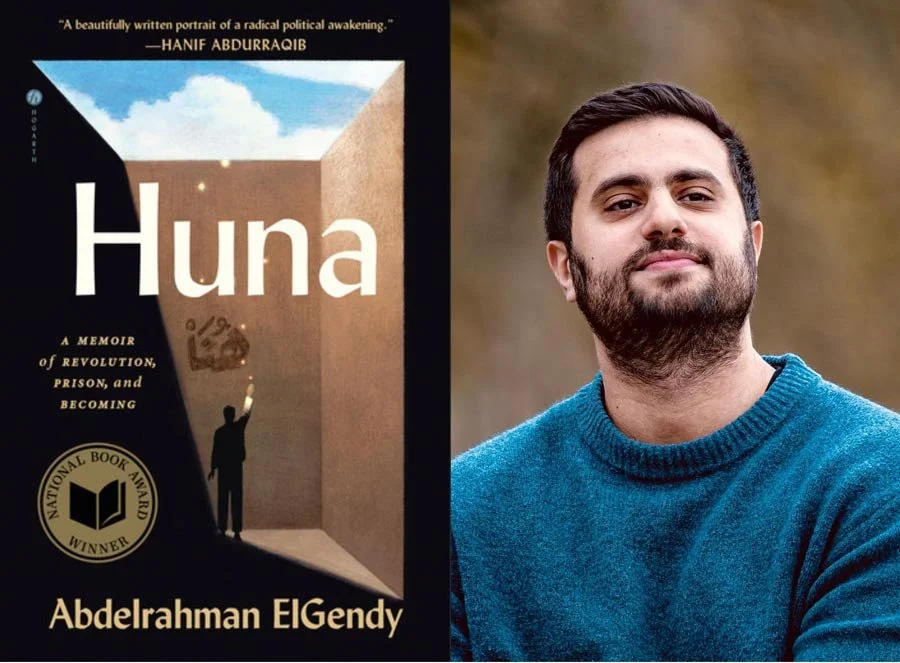
In this episode of the Speaking Out of Place podcast, Professor David Palumbo-Liu talks with Abdelrahman ElGendy. This interview was recorded on Monday, November 16, 2026, while ElGendy was in exile in Amsterdam. The Trump administration had denied him a visa that would have allowed him to attend a ceremony to receive a National Book Award for his magnificent book, Huna: A Memoir of Revolution, Prison, and Becoming. Instead, Omar El-Akkad, another recipient of a National Book Award and a previous guest on this show, accepted for him. Huna tells the remarkable story of a young, 17-year-old Egyptian who is thrown into prison, along with his father, for simply videotaping at a protest at Tahrir Square on October 6, 2013. They are immediately imprisoned, accused of being terrorists, and threatened with the death penalty.
Huna is a harrowing depiction of prison life under an authoritarian regime, but also of a growing understanding of life, politics, friendship, and family. It is filled with brutality and beauty, and ultimately becomes a story that focuses on journeys, rather than destinations. It offers a radical and wise understanding of solidarity, art, and commitment.
Abdelrahman ElGendy is the author of Huna: A Memoir of Revolution, Prison, and Becoming, winner of the National Book Award. A winner of the Samir Kassir Press Freedom Award, ElGendy holds an MFA in Creative Nonfiction from the University of Pittsburgh and an MSc in Human Rights and Politics from the London School of Economics and Political Science. His work appears in The New Yorker, TIME, The Washington Post, The Nation, The Baffler, the Los Angeles Review of Books, and elsewhere.
DAVID PALUMBO-LIU
Welcome. It's such an honor to have you on. It's an absolutely stunning achievement. It tells an unbelievable story in such a powerful way, and this is actually absolutely true: I found myself so immersed in a chapter or even a few pages, I would get up and be completely disoriented when I would walk outside and see—here I am in the middle of suburbia—because you do such an incredible job of describing an experience that none of us will ever have, right? But you managed to convey this, and I thought maybe we could start our conversation by talking about the title of the book. You have a very powerful statement on page 282 about the word Huna and what it represents, and I was thinking about the passage that begins, "It stopped mattering whether I was working toward an end," and then I thought we could stop maybe around,"Huna becomes a kind of a home." Could you read that section, please?
ABDELRAHMAN ELGENDY
"It stopped mattering whether I was working toward an end. It became the working toward that I sought, not the from, not the to, but a mode of being in the world. One these walls were built to still. Maybe the struggle couldn't be conquered, and maybe that was okay. Maybe all that mattered, truly mattered, was that we could still hold and be held. Perhaps what I mean to say is this: there's a certain futility in seeking an arrival when you carry your ghurbah in your bones. Perhaps it is about seeking out the fellow exiles, those like us, yearning together toward an untenable homecoming, a light in the tunnel instead. This communal pursuit within the ghurbah of the huna becomes itself a kind of home."
DAVID PALUMBO-LIU
Amazing. And I was thinking about how you begin the book. It's almost like a home seeking for civil society, right? Could you talk a little bit about the historical context that begins this book, and what drew you into the streets? What kind of a huna were you hoping to find there, or maybe had already discovered?
ABDELRAHMAN ELGENDY
Yes, I was 17 at the time of my arrest, so I was pretty young. And I always speak about this book, and I'm always careful to emphasize that it's also a coming-of-age story. In the subtitle, the becoming part is equally as important—maybe even more important—than the revolution, prison and becoming. Because many people have a knowledge cutoff at 2011, Tahrir Square, that kind of thing in Egypt, and then after that everyone's like, "Yo,whatever happened there?" And many people have no idea what happened, and in 2013, there was a military coup that took over the country, and the counter-revolution basically defeated the revolution, and ever since we've been under a very vicious military dictatorship. And what I think about as the founding violence of this military dictatorship is the Rabaa massacre, which took place in August 2013. And in it, the military and police massacred what some estimate are up to 2,000 protesters. And it's the moment when the regime transmuted its kind of coercive power into political legitimacy, basically, with that spectacular violence against the bodies of dissidents.
So what touched me personally on that day was that the father of one of my dear friends was one of the people who were killed on that day. And as I mentioned, I was 17, she was 16. I had a little crush on her. That was just a silly reason for a political awakening, but it's often these little small things that get us thinking about things. And this was the way in which politics touched me directly. I was following this girl. Suddenly she was crushed by the death of her father, or the murder of her father. I attended the funeral, and in Egypt at the time, funerals of martyrs would often turn into really major protests after. So this was how I got involved in this first big protest. Before, at the time of the revolution, I would dip in and out of marches out of curiosity mostly, because, yes, we were pro-revolution, as everyone who had any kind of conscience was pro-revolution from afar, from the sidelines. But this was one of the first protests that I actually attended out of conviction, and I always think about it as the moment of political awakening that called me to go to the streets.
And then I started attending protests again and again. Once I attended that one and I saw the families of other people who were murdered and massacred in the Rabaa massacre, I started reading up on what happened and educating myself and attending protests, and I got really so deep into it. I would attend something in the morning, then in the afternoon, then at night and then go and read and consume media. And so I was really just so deep in it. And eventually, on October 6, 2013—this was just two months. I had this two-month window of political activism. October 6, this is the Armed Forces Day in Egypt, and so the protesters wanted to break into Tahrir Square as sort of a symbolic gesture because it's a military coup, Armed Forces Day, so they wanted to break into Tahrir as a symbolic act of dissent.
And my parents were really worried about that. At that point, they'd been tolerating my rebellion. It was like teenage rebellion, et cetera. Let him do it. But that day, they knew that Tahrir itself, because of its revolutionary symbolic value,the police get really brutal when it comes to Tahrir. It was barricaded. People would not be allowed into it. So what happened was my parents were really angry at me for wanting to go to this protest. They wanted to prevent me, and then eventually, the kind of compromise that we reached was my mom forced my father to basically chaperone me to that protest. My father didn't want to be there, but he ends up going with me. We head to the protest. I exit the car, he calls me back inside, and then I start shooting a video, and I don't notice that there are two plainclothes officers standing right next to the door who end up wrenching the car open, grabbing me out and starting to beat me, and then my father tried to grab me away from them, so they end up arresting me and him together, and this is how it all begins.
DAVID PALUMBO-LIU
I'd like to talk about your parents, actually, not just in terms of the role that they play during the main narrative, but what was their attitude toward the revolution and the counter-revolution? In other words, you talk in great detail about the, if you might say, ascendancy of your father through incredibly hard work. He has a business and he has the beginnings of a pretty good life. But how did they witness you all doing this, and how did they feel about how their own lives were part of this or not part of this?
ABDELRAHMAN ELGENDY
Yeah, I always speak about this because it is integral to how I came to all this. My family was very apolitical. Actually, middle-class families in Egypt, you're just focused on upward mobility. That was the case for my family. It is very commonly known that politics is bad. We don't get involved in politics. Politics gets you into bad things. So mostly we were brought up that way, to not think about politics in that way, to just think about wanting to be a good student, get a good job, good education, stuff like that.
So my parents were the same way. My father was from a working-class neighborhood, and his whole life was this restless pursuit of upward mobility to provide for us. So this was my father's entire life, just hustling for a better life for us, and when the revolution happened, I think my parents were just like many Egyptians. We were politicized in the sense that we felt like we were aligned with what was happening, but also from the sidelines. We wouldn't actually go into the streets,which is how a lot of people were first interacting with the revolution and the movement in the street. And then when Mubarak fell in February 2011, that's when we started actually going to the street in a more kind of festive atmosphere. So it was people heading to the square to celebrate the fall of Mubarak, but there wasn't so much risk attached to that. It was,at that point, more of a celebratory kind of thing. So this is how my parents introduced us to this whole thing. We went to Tahrir. We walked through the square. This was my own memory of the revolution at the time, very festive. There was something very transcendent about it. I still recall it in my body. I'm so grateful that they took us there because it is a thing I think one cannot forget, and also one can say you can experience once in a lifetime, maybe never, to be in a space of such revolutionary rapture and joy and euphoria. To me, I still recall this in my body.
And then what happened is, once the military coup happened and all that, again, my family, same thing. They were sympathetic again from the sidelines. But at the time, they noticed that I was getting dragged into being actually on the streets. At this time, they didn't control what I consumed, how I went on the street, people I was interacting with. So I think, and I mentioned this in the book, they were really worried, but also they were like, "Let's tolerate this. He's coming into his own political awakening." In a way, I would come back and have all those new terms about things I speak about—tear gas, the gloves and how to layer up so rubber bullets wouldn't—so they thought about it all in the abstract. He's just learning about all of these things and coming into his own political consciousness.
And this is why when it got to October 6 specifically, it was too much because again, as I mentioned in the book, even my mom, who was more vocally supporting me when I was doing this—thinking it's a good thing, you should be learning,educating yourself—started hesitating about what she might have ushered into our lives. Realizing, oh, we're getting too sucked into this world. I think I repeat throughout the book the idea that we were not built for this world, right? My father would constantly have this refrain almost that I keep recalling throughout the book. He told me from the beginning, when I almost got arrested at one of those protests, and he started yelling at me and telling me, "We're not built for this world.We cannot run behind you in police stations. That's just not who we are. We were not built like this." That's why in the book I recall this moment so much, because guilt is also a running through line in this book.
DAVID PALUMBO-LIU
Yeah. Obviously, we'll talk a lot about your transformation, but I'd be interested in talking about your mother's transformation. She becomes, from this particular incident, drawn into a whole new world. Speaking of worlds you don't belong in, and yet she becomes absolutely fluent in it. I mean, she's making meals for 30 prisoners.She's smuggling things in and out. She's learning this world in order to preserve you and your father, and you write at one point, "I've seen Mama in many states. Alight as if she had inhaled the sun, fragile as if a touch would shatter her, wearing that prescient smile that knew of pain yet to come, but I'd never seen her like this, fierce like a brewing storm." "They cannot hurt you. They're powerless." There's so much in that. Could you unpack that a little bit for us?
ABDELRAHMAN ELGENDY
Yeah, absolutely. My mom, I guess she's such a central pillar of this book. The book tackles my relationship with my father, which is more tense and has all those silences, but I've always been very close to my mom. We would verbally express love to one another in a way that I didn't have with my father. And I was really protective of my mom, as people often are. But I think my mom also had a heart condition, and I speak about this in the book. I was protective of her also in a very material sense, in that her health actually made her vulnerable to so many things. She literally wasn't built for this. Her body couldn't take this. Sometimes we would speak in visitation, and she'd tell me, "I have no idea how I'm still alive bearing this. I don't understand, medically speaking, how my heart is..." Because before prison, my mom couldn't even walk. We had to exit the house first and go turn on the AC in the car because the heat from the little walk from that front door to the car—she couldn't take that, because she had a condition that made it difficult for her to breathe and do any kind of really heavy lifting, any kind of those things...
SHOW FULL INTERVIEW (15:00+) ▼
CLOSING THOUGHTS (0:00:00+)