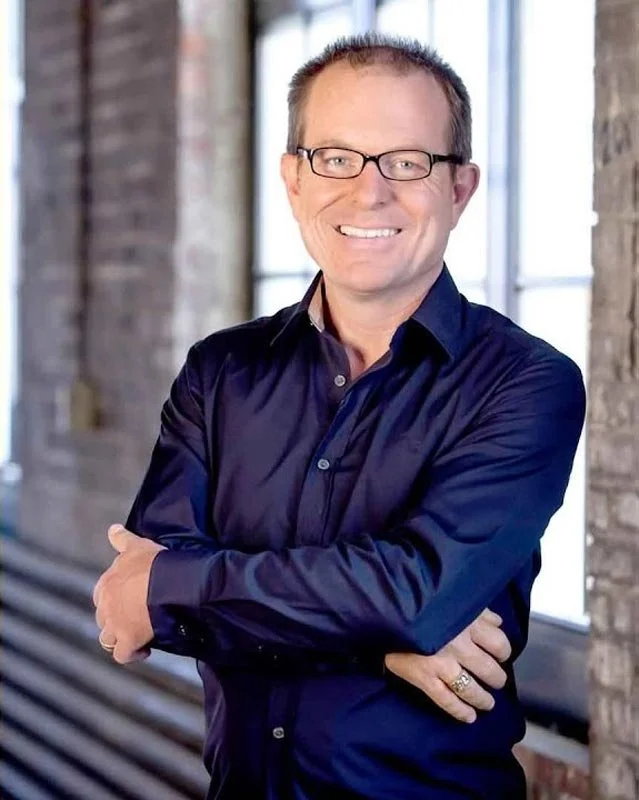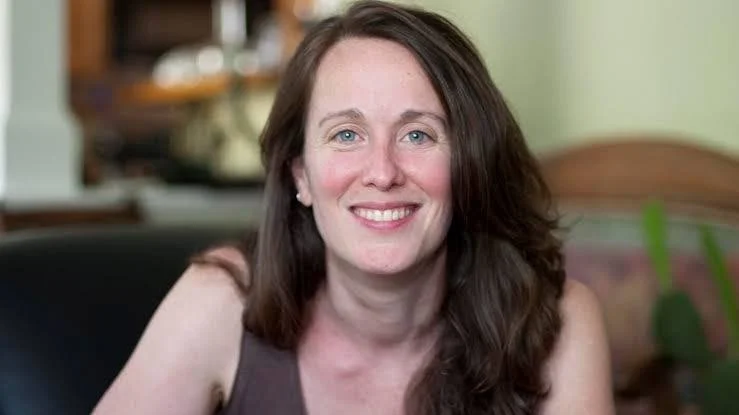


Laurel Snyder is the author of many books for children, including the Geisel Award-winning Charlie and Mouse series, and Orphan Island, which was long-listed for the National Book Award in 2017. Originally from Baltimore, Laurel now lives in Atlanta, where she is finishing work on a graphic memoir, Fairy Hunter: The Truth and Other Stories. @ohmylorelei
Where were you born and raised? How did it influence your writing and your thinking about the world? That's the place to start, isn't it? I was born and raised in Baltimore, and that definitely had a major impact on every aspect of my life. My parents were young and they didn't have a lot of money, and then they divorced and lived in different parts of the city, so my siblings and I spent a lot of time getting from place to place, roaming around in a semi-feral way, on foot or by bus.
I really loved my home and childhood. I never meant to leave it, really, but I was awarded a scholarship to go to college in Tennessee, and then the same thing happened again in graduate school, so I found myself in Iowa. After that, I followed a job to Atlanta, and somehow I never made it home. Maybe that's my next chapter!
There are so many different ways that Baltimore influenced my writing. To begin with, it's not a slick city. It's full of makers and doers, people with a really strong DIY spirit, and I encountered a lot of artists and writers as a kid. The cost of living is cheap, and that lowers the barriers to participation in the arts. People start small magazines and reading series, theater groups, and studio spaces. There are so many wonderful small bookstores. And Baltimore has an extraordinary library system. I definitely felt like I grew up surrounded by books and art, and all of it felt accessible, available to me. I started writing when I was about eight, and then in high school I had a really wonderful creative writing teacher, who was a poet himself, ran a small press, and brought lots of his friends in to read to us and sit in on our workshops. I was very lucky to be immersed in literature as a kid. And lucky to not have it professionalized before I had figured out I wanted to participate.
What kind of reader were you as a child? What books made you fall in love with reading as a child? Oh, gosh. This is the story I end up telling more than any other. I spend a lot of time sharing this with kids.
Like I said, my parents got divorced when I was young. And luckily, Baltimore has an extraordinary library system. Those two facts are really important to my story, because the truth is that I was very sad and lonely, in exactly the years when I was becoming an independent reader. But also (thank goodness!), there was a branch of the library across the street from my school. Because I was the oldest kid in the family, and because my mom couldn't afford for all of us to go to after-school, I was allowed to walk to the library, and read and do my homework until she got off work and came to get me.
So I just read and read and read, all the time. And I found that when I was reading, I wasn't so sad. When I was reading, I was able to avoid thinking about the things that made me sad. Books were distractions, and they were a kind of company. Also, when I met my best friend (she's still my best friend), I discovered that books could be a kind of bridge to her. We shared books we loved, and that was a bond.
Because I spent so much time reading, I read everything, more or less. Fiction and nonfiction. Poetry and picture books. I chewed through the children's section and then started on all the informational books upstairs in the adult room. Time-Life Encyclopedias about the Occult. Coffee table books about ballerinas. But my favorite books were (and are, still) books that blur the line between reality and magic in one way or another. I loved books where regular kids had adventures beyond daily experience. Portal stories like The Chronicles of Narnia, or books in which kids discovered magical powers, like the Edward Eager books, or books where kids reached for magic and didn't quite find it, like The Egypt Game. I also loved fairy tales a lot, and poetry. Oh, and I loved sad books! I loved Oscar Wilde's stories. Little Women. Things that made me cry.
Describe your typical writing day. I'm all over the place right now! For years, I had a really pat answer to this question. I'd have told you I was a plotter when I write novels, but that I approached picture books as poetry. I'd have explained that with small kids and limited childcare, I had to make the most of my writing hours.
I had this thing I used to do, when my kids were young, where I'd get them off to school, and then get back into bed, but set a 15-minute timer. Because I found that if I could wake up in a quiet house, I was much more productive. I called that my "bubble brain."
But then Covid happened, and I found that I could never find my bubble brain. Even when the house was quiet, I could never write with my kids in it. And then, after they finally returned to school (we did distance learning for more than a year), it was like my brain didn't work anymore. I don't know if it's fair to say I was blocked, because I did put words on the page. Just never the right ones.
Then, about two years ago, I discovered The Artist's Way, and that removed the pressure and helped me get back into the habit of just scribbling for myself. Slowly, I started making new work again, writing things that felt better. And now, just this week, my youngest kid left for college. So I find myself in this funny place where I can feel the stories and the poems sort of lurking, hovering, and I also have ample time to devote to them. I think maybe I'm about to establish a new routine, a new "typical writing day." But I'm not sure what it is yet. I only know that I have a long list of things I want to work on, and for that I'm very grateful!
Part of me wonders if I might not revert to habits I had twenty years ago, before I became a parent. I used to stay up very late at night, reading and writing, and then sleep late into the morning. Am I allowed to do that now? Will my menopausal brain let me? We'll see.
Tell us about the creative process behind Orphan Island or a project you are currently writing. This is funny timing! Because the book I'm about to embark on is a sequel to my best-known work, a middle-grade novel called Orphan Island. And I've been thinking a lot about the creative process of that book.
When I wrote Orphan Island, I was at a low point, creatively. (I've had a lot of low points. I tend to dip down every few books, declare that I might be finished writing for good, and then come out of the slump). The truth was that I'd just published a book that felt like a compromise, and I didn't like that feeling at all. I'd published a fair amount by then, and the writing process had become more professionalized than was comfortable. I had this idea that I should be able to produce a book every year or two (in children's publishing, this is common), but that felt like churn to me, like content creation. Not like art.
Finally, I told my agent I was done, that I didn't want to sell any more books if it was going to feel like that. I decided to get a day job, and I did.
But then, after some months, this odd little story crept into my brain, this idea of an island full of children. It grew out of my bedtime reading with my kids (We'd read The Little Prince, followed by My Side of the Mountain). And I decided that if I was going to protect this new idea from my professional brain, and keep it feeling magical, I would need to write by hand, the way I had as a kid.
So that's what happened! I wrote the first draft of Orphan Island longhand, and I did a lot of paintings and drawings to go with it. I really wanted to use my child-brain as much as possible. I wanted the process to feel like play, the way it had when I was starting to write as a kid. When I was full of new thoughts and feelings, and had only just discovered the magic of the page.
Which brings us to today, I guess. To now. I've spent the last eight years telling people I would never publish a sequel to that book, but now, an exciting idea has presented itself. I'm coming out of yet another low period in my writing. So it certainly feels like the right thing to do is to go back to my paints and crayons and get a fresh legal pad and a good, sharp pencil and tackle this draft by hand the way I did the first.
Though I also have arthritis now, and writing by hand hurts, so I may have to go more slowly...
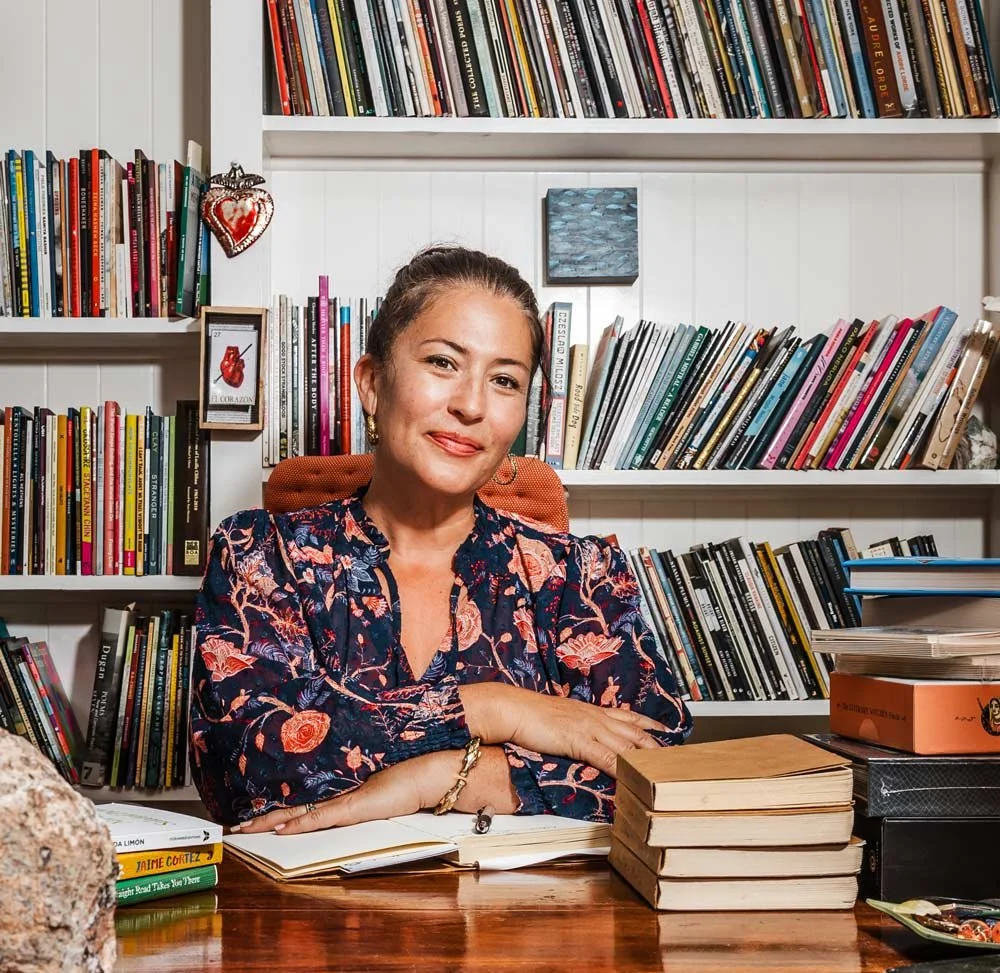
Upload a Photo(s) of Yourself (required), Your Handwritten Notebooks, Your Books, Manuscript Pages, Your Writing Desk, etc. (optional).: resized-Laurels-Desk.jpg
Do you keep a journal or notebook? If so, what’s in it? I keep about seventeen of them. I'm perpetually buying a good, fresh notebook, and then filling it with a random assortment of journal entries, story starts, grocery lists, doodles, etc. But I leave them all over the place, and so there's no way to know what was written when. It's really annoying. I'll find a tote bag in the back of my car, and pull an old Moleskine out of it, with no context at all.
How do you research and what role does research play in your writing? My projects are all so different, and it depends! For the most part, I don't think of myself as a research-based writer, but I'm currently working on a picture book about Sylvia Beach, so I've been reading her letters and memoir, and it's really transforming the book.
Which writer, living or dead, would you most like to have dinner with? That's an impossible question! But maybe James Thurber? He's someone whose work touched me as a kid and also as an adult. That's really significant to me.
Do you draw inspiration from music, art, or other disciplines? I can't actually write with music on at all. I need total silence. But music is a huge part of my life. My husband is a musician, and my younger son plays too, so my house is full of music. We see a ton of live music, and travel pretty frequently to see bands. In fact, I once wrote and recorded some country songs myself! And at my last workshop in grad school, I submitted songs instead of poems. I'm interested in how music and language intersect.
Also, sometimes I'll task myself with trying to write something that has music embedded in it. One of my novels, Bigger than a Bread Box, is sort of wrapped around the Springsteen song, Hungry Heart. And another book, My Jasper June, has some Leonard Cohen in it.
AI and technology are changing the ways we write and receive stories. What are your reflections on AI, technology and the future of storytelling? And why is it important that humans remain at the center of the creative process? I don't feel qualified to speak to AI, as a paradigmatic shift or destroyer-of-worlds or useful technology, though my friend Martha Brockenbrough has written a great book about it called Future Tense, and I highly recommend it. I accept that AI exists in the world, though I'm not especially interested in exploring it myself.
What I can say instead is that I think the person who benefits the most from the creative process is the artist. So I don't really understand how AI can replace the creative process for anyone who really cares about art. I write because I'm perpetually trying to figure out who I am and because I'm trying to understand the world around me. I honestly can't imagine a world in which people aren't engaged in that process.
Tell us about some books you've recently enjoyed and your favorite books and writers of all time. I just finished Lily King's new novel, Heart the Lover, and I loved it. I read it all in one nostalgic, pleasurable gulp. I'm a sucker for a book about writers and writing. Not unrelated, I also recently loved Heather Christle's In the Rhododendrons: A Memoir with Appearances by Virginia Woolf, though it's a much harder and more painful read. I sort of tiptoed through it, thinking slowly and often backing up to read a section twice. But both were the kind of books that made me feel like I was in the company of another writer, and that's one of the things I love best, that feeling of keeping company with a book.
In the realm of children's literature, I just read Kate Milford's Rialto, which is a stunning riot of a story, set in a magical abandoned theme park, full of surprises.
As for all-time favorites, I have a whole list of books I reread periodically. I have a terrible memory, and can return to books over and over and be delighted again and again. Crossing to Safety is probably my favorite book of all time. I know Stegner is problematic, but that book is one I've been revisiting all my life, and it's different each time I open it. I'll probably be clutching it when I die.
Exploring literature, the arts, and the creative process connects me to… Literature? Absolutely everything! Literature is the lens through which I best understand the world. Politics, history, human psychology, my place in the world, my identity as a woman, wife, parent. Books are the context through which the world makes sense to me.
Exploring my creative process is much more personal. I think about it a lot, and I think my relationship to my process changes as I change and grow. So an examination of process can connect me to other people who are making their way along a similar path.
I read a lot of literary and artistic biographies and memoirs for this reason. I like discovering the common ground we share. (or, as with a recent audiobook I listened to about Kurt Vonnegut, the differences between us).